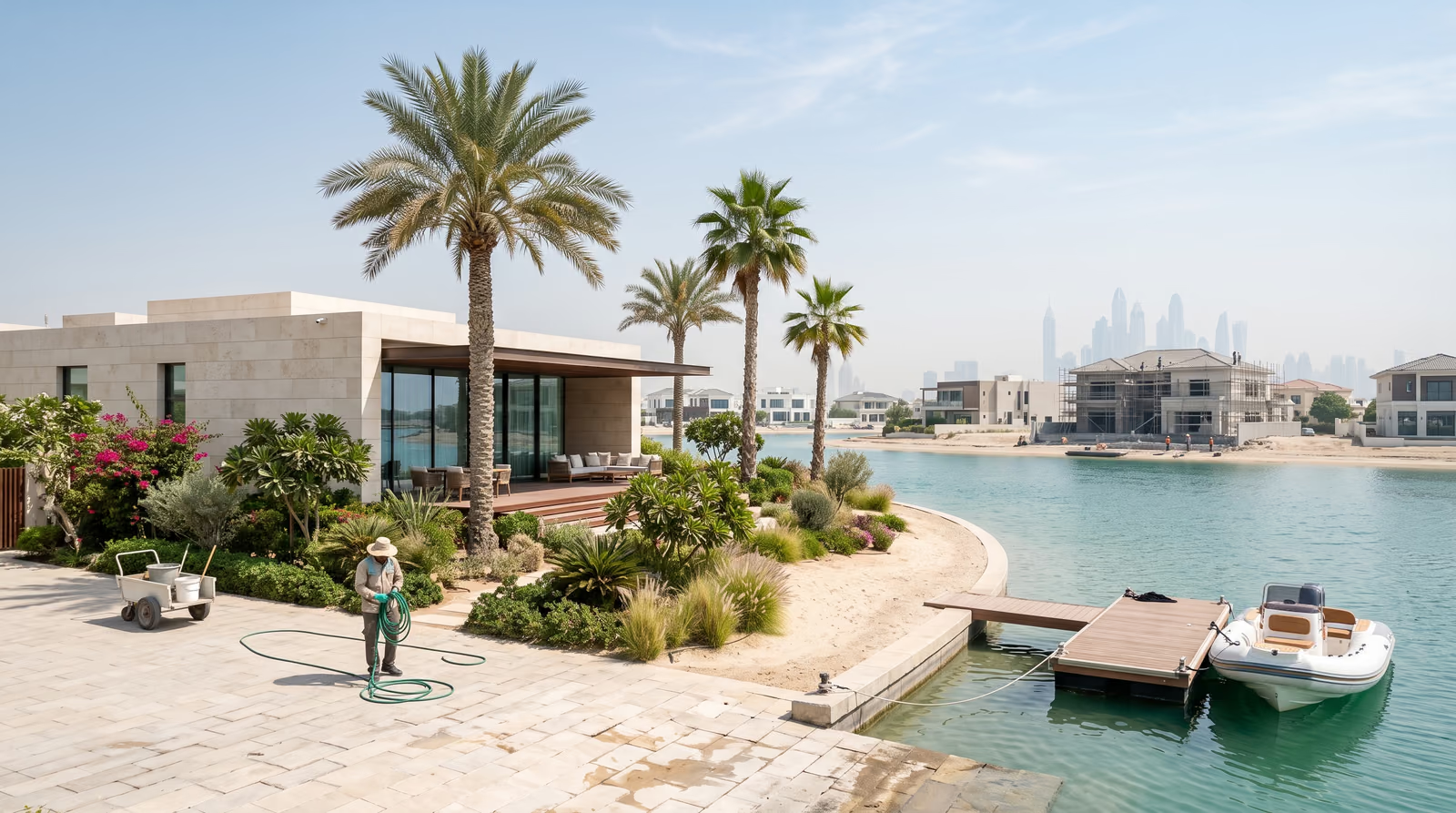
Buyers closed 296 home sales above $10 million in Dubai during the first half of 2026, worth $5.1 billion between them, according to Knight Frank's analysis of Dubai Land Department records. That is 16% more deals than the same period of 2025, 14% more money, and 49% more transactions than the first half of 2024. Twenty six of those homes changed hands above $25 million, itself a record.
The rest of the city went the other way. Dubai's wider residential market recorded Dh221.3 billion across roughly 79,200 transactions in the same six months, 14% fewer deals than a year earlier and 15.7% less value, on figures compiled by Cavendish Maxwell. Nicholas Spencer, head of residential for the Middle East and North Africa at Knight Frank, describes prices ebbing across the mainstream market by between 5% and 20% depending on location.
Two markets, one city, moving in opposite directions. That divergence, not the record itself, is the story.
One City, Two Markets
Dubai residential sales, first half of 2026 against the first half of 2025
Homes above $10 million
The trophy segment, on Knight Frank's analysis of Dubai Land Department records
The wider residential market
All Dubai residential transactions, on figures compiled by Cavendish Maxwell
Where the $10 million and above money landed
The record half lost momentum inside itself
Sources: Knight Frank analysis of Dubai Land Department data for sales above $10 million, published July 2026; Cavendish Maxwell for the wider residential market. Largest single sale of the half: a six bedroom apartment at Aman Residences, Jumeirah Second, at $114.9 million. Dubai's all time apartment record remains the Dh500 million penthouse at Como Residences, Palm Jumeirah.
Where the Money Landed
Dubai Hills Estate led the $10 million and above segment with 51 sales. Palm Jumeirah took 50 and Palm Jebel Ali 40, which is notable because Palm Jebel Ali is still substantially a construction site. Buyers are paying eight figures for delivery positions on an island that does not yet exist in finished form.
The largest single transaction of the half was a six bedroom apartment at Aman Residences in the Jumeirah Second community, at $114.9 million, or about Dh422 million. Knight Frank also logged a $76.3 million villa on Jumeirah Bay Island and a $152.5 million plot of roughly 80,000 square feet on Naia Island, land alone, with the house still to be built.
One clarification matters here, because it is widely misreported. The $114.9 million Aman deal is the biggest sale of this half year, not Dubai's all time apartment record. That record still belongs to a five bedroom penthouse of almost 22,000 square feet atop Nakheel's Como Residences on Palm Jumeirah, which sold for Dh500 million, just over $136 million, and which is not scheduled for completion until 2027. Dubai's headline record was set on a building that has not been finished.
The Top End Cooled Too, Just Later
Split the half into quarters and the record looks less linear. Knight Frank counted 165 sales above $10 million in the first quarter and 131 in the second, a fall of about a fifth. The half year total still beat every previous half year, but the momentum inside it faded, and it faded in the same quarter that the mainstream market was contracting.
Individual trophy prints kept landing regardless. Villa Gaia, a roughly 22,000 square foot house on Jumeirah Bay Island developed by Alta Real Estate Development, sold for Dh280 million in June, comfortably above Dh12,000 per square foot. In August a villa at Jumeirah Golf Estates sold for Dh110 million through BXB Estates, a built up area of 21,714 square feet on a 15,873 square foot plot, working out at roughly Dh5,066 per square foot. That deal nearly doubled the community's previous ready villa record of Dh58 million.
Read together, those two prints show location premium doing the work rather than square footage. Jumeirah Bay Island, a scarce waterfront enclave, trades at more than double the rate of a large golf course villa inland.
The Same Pattern Aviation Already Knows
Fewer units, more money, concentrated at the top. Anyone who follows the markets AVNET covers has seen this shape before.
The superyacht market printed it almost exactly. As AVNET reported on the first half of 2026, buyers took 326 preowned superyachts off the market, eight percent fewer than a year earlier, and paid $3.51 billion for them, fifteen percent more. The average boat sold for roughly $10.8 million, up about a quarter.
Business aviation shows the value half of the same trade. Global Jet Capital's second quarter brief put average preowned bluebook values up 2.9% year over year, in a category most buyers assume only depreciates, a finding AVNET examined in detail in its analysis of whether private jets hold their value.
The mechanism is the same in all three. When the supply of genuinely good assets is thin, transaction counts stop measuring demand. Money that cannot find a Palm Jumeirah villa, a 60 metre motoryacht or a low hour large cabin jet does not disappear. It concentrates into whatever does come to market and bids it higher, which is exactly what produces falling volumes and rising values at once.
Why This Sits on an Aviation Title
The buyer is the same person. Dubai's ultra prime market and its private aviation infrastructure are two purchases by one cohort, and the second is what makes the first practical. The emirate's build out of Al Maktoum International as its dedicated private aviation hub, which AVNET covered in its report on the move to DWC, is part of the same offer as the tax position and the residency programme.
That link is not theoretical. AVNET's earlier reporting on Florida traced how private jet access reshaped luxury residential demand in Palm Beach and Miami, drawing buyers who needed to be somewhere else two days a week and could be. Dubai is running the same equation on a larger balance sheet.
What to Watch
The obvious question is whether the second quarter slowdown at the top was a pause or a turn. Knight Frank's own framing points to a two speed market rather than a cooling one, with prime holding while the mainstream normalises after several years of exceptional growth. Faisal Durrani, the firm's head of research for the Middle East and North Africa, notes that Dubai's luxury market has broken records consistently for five years running.
The third quarter prints, due in October, will settle it. If the $10 million and above count falls again while the mainstream keeps softening, this stops being a two speed market and becomes a single market cooling from the bottom up. If the top end reaccelerates while values slide elsewhere, Dubai has made the transition every mature prime market eventually makes, where the trophy segment stops tracking the city it sits in and starts tracking global wealth.