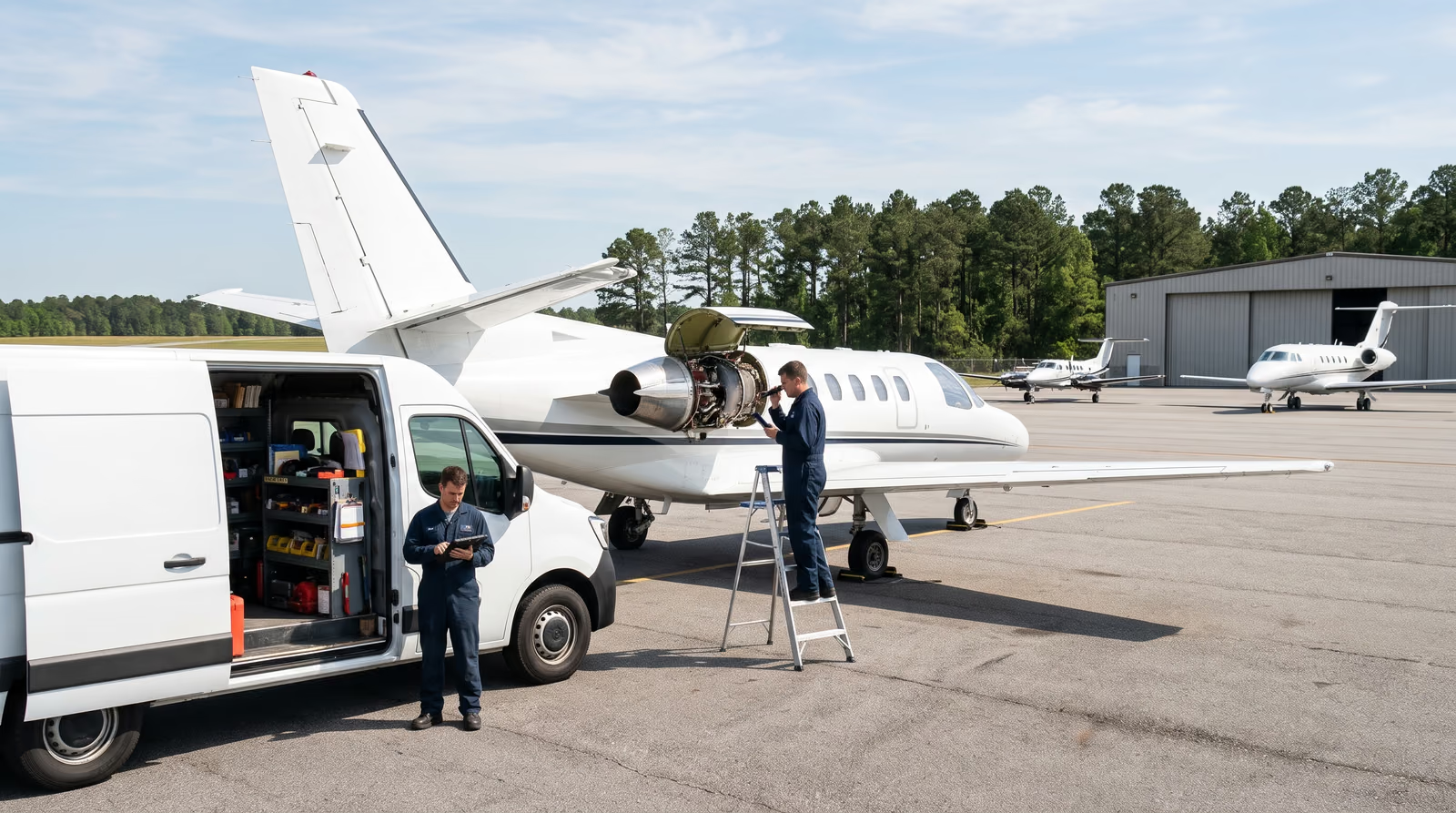
flyExclusive, the North Carolina operator behind the Jet Club card and a fractional programme, reported record quarterly revenue of $111.1 million for the three months to 30 September 2026, up 21% from $92.1 million a year earlier. Its balance sheet tells a second story. At the end of the quarter the company held $19.6 million in cash against $139.9 million of current deferred revenue, most of it flying that customers have already paid for and not yet taken. That is about seven dollars of prepaid flying for every dollar of cash.
Both numbers come from the company's own filings: the third-quarter results release and the quarterly report (Form 10-Q) filed with the US Securities and Exchange Commission on 12 November.
A better quarter on fewer aircraft
The operating picture improved sharply. Gross profit rose 95% to $24.6 million and gross margin reached 22.2%, against 13.7% a year earlier. Adjusted EBITDA, a non-GAAP measure that strips out interest, tax, depreciation and some other costs, was a positive $5.1 million against a loss of $1.9 million in the third quarter of 2025.
Aircraft on its certificate fell from 90 to 73, a drop of 19% on the figures in its results table, while flight hours rose 7% to 19,660. Dispatch availability, the share of the fleet ready to fly, climbed to 58.2% from 48.9%. "Today, we're flying more hours with fewer airplanes," chief executive Jim Segrave said in the release.
According to Private Jet Card Comparisons, which covered the earnings call, flyExclusive has now exited 35 of 37 legacy aircraft it identified in early 2024, and management said those aircraft had been costing about $3 million a month in operating losses.
Sales to retail customers grew too. Jet Club sales reached $38.6 million, up 22%, and fractional and flight-fund sales were $16.8 million, also up 22%. Private Jet Card Comparisons reports that new jet card sales rose 43% and renewals 11%.
The company still lost money. The 10-Q shows a GAAP net loss of $13.0 million for the quarter, narrower than the $21.1 million loss a year earlier.
What the balance sheet says about customer money
Deferred revenue is money a customer has paid for a service not yet delivered. For flyExclusive it is mainly prepaid flights: jet card deposits and fractional programme payments. At 30 September the company carried $139.9 million of it as a current liability, up from $135.9 million at the end of 2025, plus a further $31.0 million due beyond twelve months. In total, $170.9 million of flying was owed to customers.
Cash was $19.6 million, up from $14.2 million at the end of June but down from $29.3 million at the end of 2025. Divide the current deferred revenue by the cash ($139.9 million by $19.6 million) and the ratio is 7.1 to 1.
That is not, on its own, a warning. A jet card operator is paid in advance and delivers later, so its liabilities to customers will always run ahead of its cash. The 10-Q says as much: the company has "consistently maintained a working capital deficit", which it attributes mainly to prepaid flights, and describes this as common in private aviation. At 30 September its current liabilities were $284.3 million against current assets of $84.2 million.
The filing names the growth in prepaid flight revenue as a principal source of liquidity. Over the first nine months of 2026 the company took in $244.1 million of new prepaid revenue and recognised $235.6 million as flights were delivered, so the balance kept growing.
What a card holder wants to see is the business generating cash from flying rather than relying on new deposits to fund old ones. On that point the quarter was encouraging. Operating cash flow for the nine months was a positive $6.1 million, against an outflow of $10.3 million in the same period of 2025, and management guided to positive operating cash flow in the fourth quarter. Long-term notes payable stood at about $136.0 million, which the release says is $13.0 million lower than a year earlier and $106 million lower than two years earlier.
Reading it as a buyer
AVNET's guide to the checks a jet card holder can run on the company holding their deposit was written around a broker that sold flying it did not operate. Its central test compares the free flying a provider gives away with the cash it takes in, and it suggests asking how the provider pays the operators that fly its customers and searching the financing statements filed against it. flyExclusive differs from that case in one important way: it holds its own operating certificate and flies its own fleet, so card money funds aircraft and crews the company controls. As a listed company it also publishes the deposit and cash figures every quarter, a comparison a private broker never has to disclose.
On those numbers the picture is mixed. Margins and cash flow are moving the right way and debt is falling. Against that, the gap between prepaid flying and cash is wide, the company is still loss-making, and much of its recovery depends on a smaller fleet keeping its higher utilisation.
Fractional, jet card and charter buyers carry different exposure here. A fractional owner holds title to a share of an aircraft, priced by flyExclusive from about $1.2 million to $4.3 million according to Private Jet Card Comparisons. A card holder holds a prepaid balance and is an unsecured customer of the operator.
One more item appears in the 10-Q. On 11 November flyExclusive signed an aircraft management services agreement with Fly Alliance Holdco, under which it will provide aircraft management, maintenance, finance, accounting and treasury services, in return for a margin over its costs and a share of Fly Alliance's profit.
All figures are in US dollars and relate to a US operator flying mainly in the United States. This article reports company filings and does not offer any view on flyExclusive's shares.
flyExclusive, third quarter 2026
A stronger operating quarter on a smaller fleet, and a balance sheet that holds far more prepaid flying than cash.
The quarter, against Q3 2025
Owed to customers vs cash, 30 September 2026
Source: flyExclusive Q3 2026 results release and Form 10-Q filed 12 November 2026. Current deferred revenue to cash: $139.9m divided by $19.6m is 7.1 to 1. US dollars.