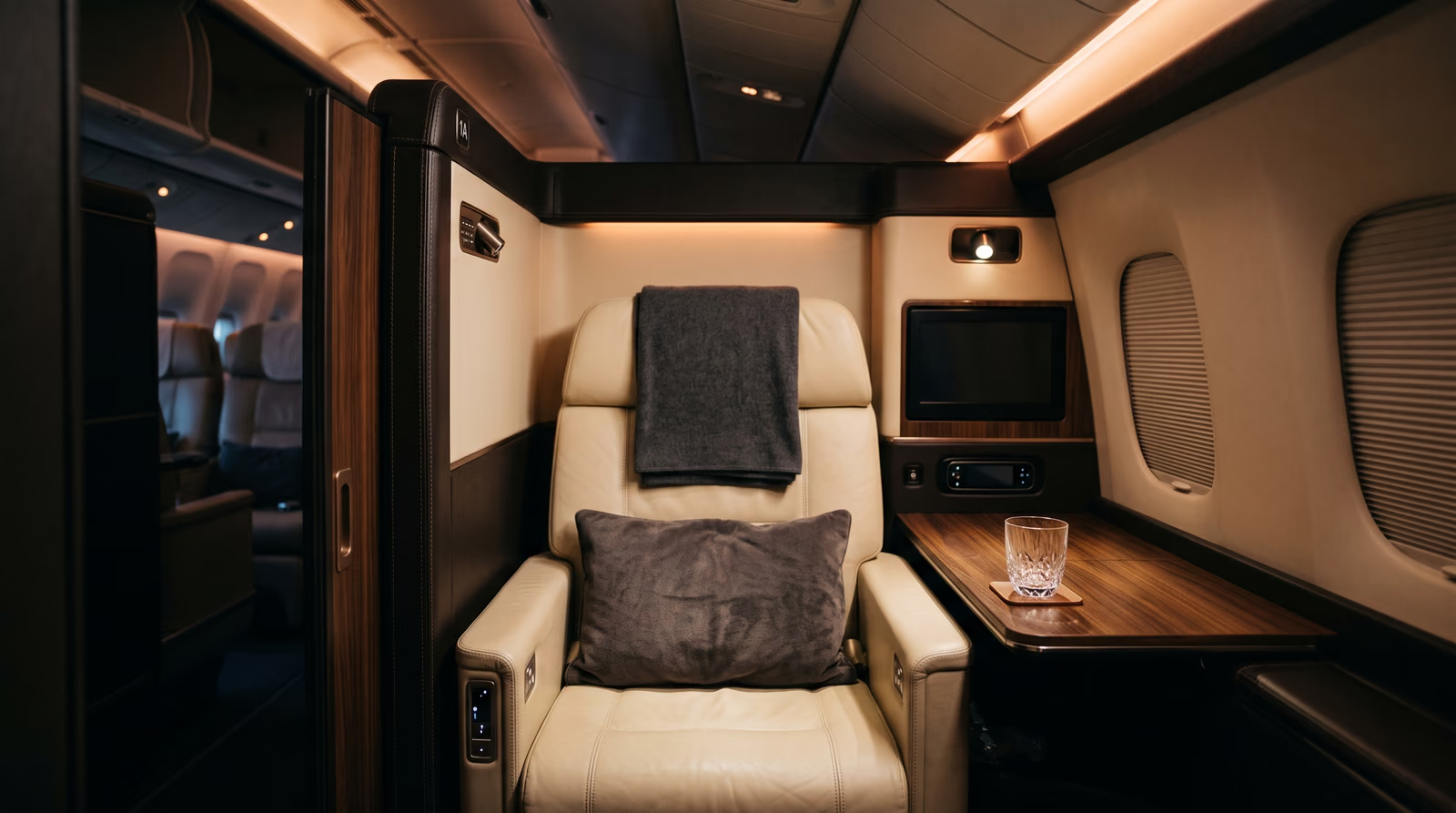
A first class return between Dubai and London on Emirates was selling for $14,069 in early August. A single leg of the same journey on a chartered heavy jet starts at roughly $90,000. Both products deliver a flat bed, a private space and a car waiting on the apron, which is why buyers put them side by side at all. The gap is wide enough that the comparison is only worth anything when it is made on identical terms: same route, same dates, same number of people travelling.
The airline figure comes from a Wego fare sample captured on 6 August 2026 for a return departing 15 October, taking the cheapest nonstop Emirates fare in each cabin for one adult. Business class on the same route and dates was $6,410. Across six nonstop routes out of Dubai, first class returns in that sample ran from $3,939 to Mumbai up to $16,443 to New York.
One buys a seat, the other buys the aircraft
The two prices are not the same kind of number, and most bad comparisons start by treating them as though they were.
An airline fare is a per person price for one seat on a departure that leaves whether or not anyone boards it. The cost of the aircraft is already spread across a few hundred passengers before the ticket goes on sale. A charter quote is a per aircraft price assembled from hourly rates, crew, fuel and fees, and it does not move when a fifth or a ninth passenger joins the manifest. Charter gets cheaper per head only by adding heads.
Hourly rates set the floor. A Simple Flying survey of 2026 operator pricing puts light jets at $3,000 to $4,500 an hour, midsize jets at $4,000 to $6,000, super midsize at $6,000 to $8,000, heavy jets at $8,000 to $15,000, and ultra long range aircraft at $18,000 to $20,000 and above.
Jet card pricing sits higher again, because the buyer is paying for guaranteed availability and a locked rate rather than a spot quote. Private Jet Card Comparisons put North American jet card rates at an average of $11,426 an hour excluding turboprops at the end of the first quarter of 2026, up 1.6% on the previous quarter and 2.5% on the year. Large cabin cards averaged $15,612 an hour, ultra long haul cards $19,301, and light jet cards $8,563.
Dubai to London
The sector runs about seven hours. Brokers quoting the route in 2026 put a heavy jet one way between $90,000 and $140,000, with European operators pricing a Falcon 2000LXS at EUR 70,000 to EUR 95,000 for the same trip. Positioning, fuel surcharges, landing and handling fees, crew expenses and taxes typically add 20% to 40% on top of the base hourly rate before the invoice is final.
Set that against $14,069. Four passengers in Emirates first class pay $56,276 between them for the full round trip, which is still less than the cheapest single charter leg going one way. Even eight first class returns, at $112,552, sit inside the quoted range for one direction on a heavy jet.
New York to London
The transatlantic run tells the same story with bigger numbers. Simple Flying's 2026 route pricing puts a super midsize charter at $85,000 to $120,000 for eight to ten seats, a heavy jet at $120,000 to $180,000 for ten to fourteen, and an ultra long range aircraft at $180,000 to $250,000 and above for twelve to nineteen. Flight time is six to seven hours eastbound and around eight hours coming home against the wind.
First class returns between the two cities can exceed $8,000 to $15,000 in peak periods, by the same publication's reckoning. At the very top of that fare range, the cheapest super midsize charter still costs what five or six first class round trips cost, and it only buys one direction.
The break-even is a full cabin
Run the Dubai to London numbers as a complete round trip and the crossover point becomes concrete. Two legs at the bottom of the quoted heavy jet range come to about $180,000. Divided by the $14,069 first class fare, that is roughly thirteen first class returns.
Where Charter Meets First Class
Dubai to London, round trip. What each passenger pays as the charter party grows.
$14,069
First class return per person, Emirates nonstop
$90,000
Cheapest quoted heavy jet leg, one direction
13 seats
Occupied before the two prices meet
Cost per person, round trip
A heavy jet round trip at the bottom of the quoted range, about $180,000 for both legs, divided by the number of passengers aboard. Bars run on a shared scale from zero to $180,000. The vertical line marks the $14,069 first class fare.
the average party $45,0003.2x the fare
a full cabin $13,846parity
The catch: a heavy jet seats ten to fourteen. Parity arrives only with an essentially full cabin, and the average charter party is 4.1 passengers.
Jet card hourly rates, Q1 2026
North American averages. Bars run on a shared scale from zero to $20,000 an hour.
Thirteen is the whole point. A heavy jet seats ten to fourteen, so charter reaches price parity with first class on this route only when the cabin is effectively full and every seat is occupied by someone who would genuinely have bought a first class ticket. Usage data compiled by Craft puts the average charter party at 4.1 passengers. At four, the per person cost of the round trip is close to $45,000, more than three times the airline fare.
Two caveats cut in opposite directions and largely cancel. A same day return is usually cheaper than two separate one way charters, because the aircraft never repositions. A trip with a week in the middle is often more expensive than the sum of two legs, because the aircraft either waits with its crew on the clock or flies home empty and comes back empty.
What the quote leaves out
Charter pricing carries a layer of costs that airline fares fold into the headline number.
United States domestic charter attracts a 7.5% federal excise tax. Peak demand periods trigger surcharges of 10% to 30%, and summer 2026 pricing has broadly tracked 15% to 20% above the previous year's baseline. Positioning charges apply whenever the aircraft is not already where the passengers are. Crew overnights, de-icing, segment fees and handling all appear as separate lines.
Two structural changes have also moved against the buyer of short hops. Private Jet Card Comparisons found jet card daily minimums rising from 81 minutes to 96 minutes over the year to the first quarter of 2026, meaning short sectors increasingly get billed as longer ones. Non peak callout requirements stretched to 66.9 hours in the same period, against 23.2 hours before the pandemic. The product is less spontaneous than its marketing suggests.
What the money buys that the fare does not
None of this makes charter irrational. It makes it a purchase of something other than a seat.
The aircraft leaves when the passengers are ready. It uses airports the airlines do not serve, and terminals where the walk from car to cabin takes minutes rather than an hour. In the Gulf that difference is now structural rather than incidental, with private traffic consolidating around dedicated infrastructure, a shift examined in AVNET's look at Dubai's move to DWC. A four stop day across three countries is routine by charter and impossible on schedules. For a board that bills by the hour, or a crew that must be in two cities before evening, the arithmetic that matters is not the fare.
What charter does not do is beat a first class ticket on cost. On these routes, at these party sizes, it never has.
The middle ground
Between the two extremes sit the products most buyers actually end up using.
Empty legs, the repositioning flights operators would otherwise fly with nobody aboard, are commonly priced 40% to 75% below a comparable on demand quote. A Frankfurt to Vienna sector quoted at EUR 8,000 has been sold as an empty leg for EUR 1,090. The trade is flexibility: the route and the departure time are fixed by someone else's itinerary, and the flight can be cancelled at short notice when the owner's plans change.
Jet cards convert charter into a prepaid block of hours at a known rate, which removes quote volatility at the cost of a higher headline price. Fractional shares go further, splitting the ownership of an aircraft across several buyers, a structure set out in AVNET's guide to fractional aircraft ownership. None of these three beats a first class fare on pure cost either. All three narrow the gap while keeping most of the access.
Which one fits
The decision is not really about luxury, since both cabins deliver it. It is about what is being bought.
A single traveller, or a couple, flying a route an airline already serves nonstop on a date they can plan around: first class wins on cost by a factor of three to twelve, and the gap is not close enough for any argument about comfort to bridge it.
A group of eight or more, flying to an airport with no convenient service, on a schedule set by the meeting rather than the timetable: charter starts to make financial sense as well as operational sense, and at a full cabin on a long sector it can match the fare outright.
Everyone in between is buying time, not transport, and should price it accordingly.