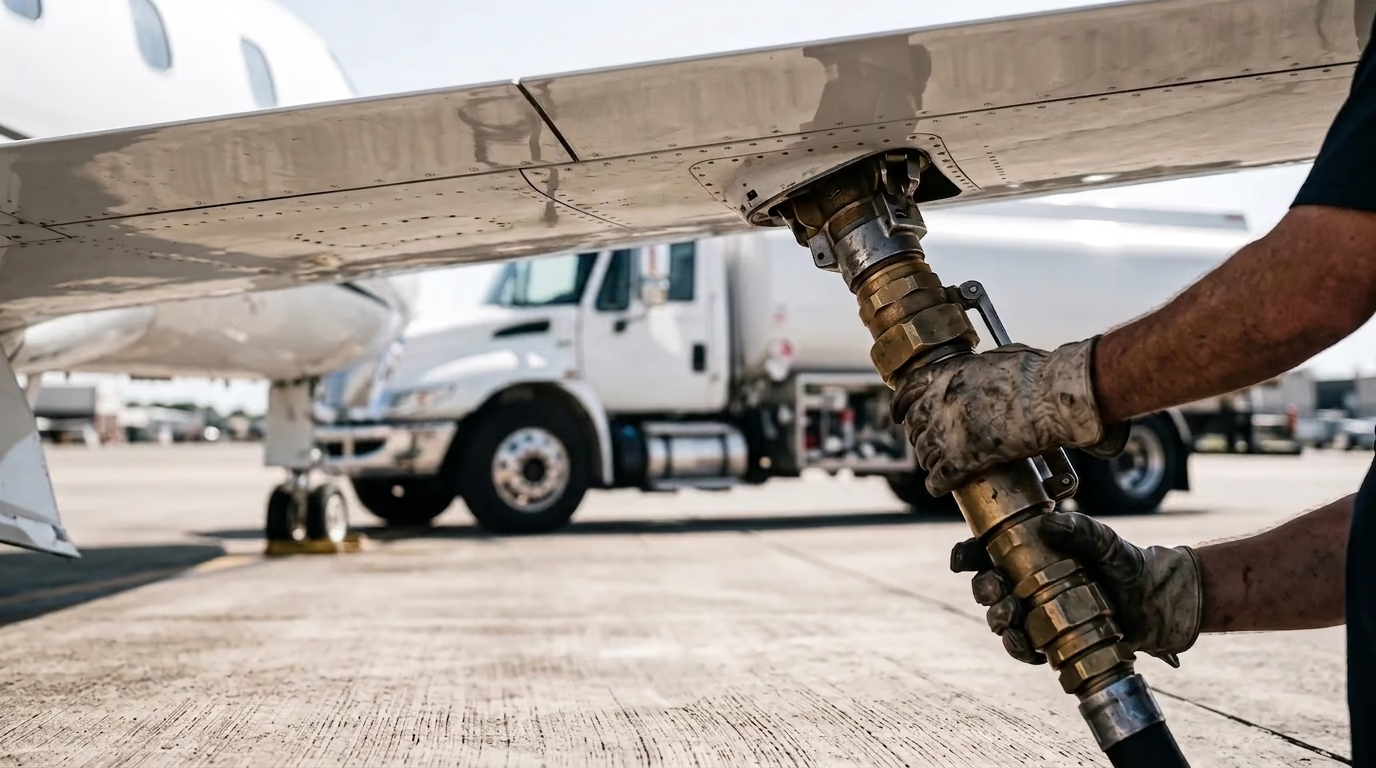
Sustainable aviation fuel carried a premium of $1,139 per tonne over conventional jet fuel in northwest Europe in March 2026, on Platts assessments reported by S&P Global Commodity Insights. Convert that at roughly 330 US gallons to the tonne and it is about $3.45 on every gallon, on top of a Jet-A price that has already climbed steeply this year. That number decides almost everything an operator needs to know about SAF. The fuel burns in the same engines and needs no modification to the aircraft or the airport. The only thing it changes is the invoice.
What The Premium Actually Is
Sustainable aviation fuel against conventional jet fuel in 2026, and what a blend adds to a midsize aircraft's fuel bill.
What the fuel costs right now
There is no single published SAF price. Airlines for America, which tracks SAF against conventional jet fuel using Argus assessments, states plainly that the market remains highly illiquid and that prices should be treated as indicative rather than exact. The invoice depends on whether the buyer takes neat SAF or a finished blend, buys at the rack or under a long-term offtake, and whether environmental credits are included or settled separately.
Within that caveat the assessed numbers cluster tightly enough to plan against. Platts put HEFA-SPK SAF at $2,640 per tonne on a CIF basis in northwest Europe on 11 March 2026, against conventional jet fuel at $1,500.75 per tonne, a multiple of about 1.76. That is narrower than the long-run average, and the reason is instructive: fossil jet fuel rose faster than SAF early in the year on Middle East supply pressure, compressing the spread. The premium had been $1,463.25 per tonne on 27 February. IATA's framing is that SAF runs at roughly twice fossil jet fuel in open markets and up to five times in mandated ones. What the fuel is and how it is made has not changed since AVNET's explainer on sustainable aviation fuel; the price and the regulation around it have.
For business aviation the relevant comparison is not the cargo assessment but the price on the ramp. Jet-A averaged $8.31 a gallon across more than 200 United States fixed base operators in August 2026, according to the Aviation Research Group survey reported by Aviation Week, up 70 cents on July and $1.70 year on year, with a regional spread from $7.36 in the Central region to $9.09 in the West. AVNET's guide to the real annual cost of owning a private jet works through what that alone does to a budget still modelled on $6.00 to $7.50 fuel. SAF sits on top of it, not instead of it.
What it adds to a trip
Current ASTM D7566 approvals allow SAF to be blended with conventional jet fuel at up to 50 percent, and most uplift sits well below that ceiling. Take a midsize jet burning 200 to 250 gallons an hour on a six hour mission, roughly 1,350 gallons at the midpoint. At August 2026 prices that is about $11,200 of Jet-A. A 30 percent SAF blend means roughly 405 gallons of SAF, and at a premium near $3.45 a gallon the flight costs about $1,400 more. Across 200 hours a year the same blend adds something in the order of $46,000 to the fuel line. At 100 percent neat, where it is available at all, the figure is closer to $155,000.
Those are planning estimates built on a cargo assessment and a standard tonne-to-gallon conversion, not quotations. The frame holds regardless: a 30 percent blend is a mid five figure annual decision for a midsize operator, neither a rounding error nor a budget-breaker.
Why the premium does not simply disappear
The comfortable assumption is that SAF is expensive because it is new, and that scale will fix it the way scale fixed solar. Carbon Direct argues the opposite in analysis updated in June 2026: the premium is structural, rooted in the chemistry and cost of the feedstocks rather than in the immaturity of the market. Waste oils and residues are a constrained resource, and already the cheapest route available.
The pathway split makes the point. HEFA, which converts used cooking oil and similar waste fats, produces almost all the SAF in existence and is the cheapest option on the board. Power-to-liquid fuels, made from renewable electricity and captured carbon, are what regulators are counting on for the 2030s. EASA has estimated PtL at around €8,700 per tonne, roughly ten times conventional kerosene. Argus, which launched the first electrolytic SAF indexes for the Amsterdam to Rotterdam to Antwerp region in November 2025, assessed e-SAF at about 13 times the cost of fossil jet fuel and 3.5 times the cost of HEFA bio-SAF. Adrian Binks, Argus Media chairman and chief executive, put the bottleneck at financing rather than chemistry: long-term offtake agreements fund the plants, and buyers are reluctant to commit.
Supply reflects all of it. IATA's June 2026 fact sheet records SAF production at 600 million litres in 2023, one million tonnes in 2024, 1.9 million tonnes in 2025 and a projected 2.4 million tonnes in 2026, which is 0.8 percent of aviation fuel use. Growth is slowing, not accelerating. IATA put the cost to airlines of that volume at $4.3 billion, without breaking out how much is premium, and separately recorded a $2.9 billion premium paid in 2025. Marie Owens Thomsen, IATA's Senior Vice President Sustainability and Chief Economist, called the 2030 e-SAF targets set by the EU and the UK beyond unrealistic. Those mandates imply roughly 0.6 million tonnes of e-SAF by 2030, against global e-SAF capacity of about 0.02 million tonnes.
The policy layer, which is where the price actually moves
Three regulatory levers set the SAF price an operator sees, and all three moved recently.
In the United States, the incentive shrank. The 45Z clean fuel production credit carried a preferential rate of $1.75 a gallon for SAF under the original Inflation Reduction Act framework. H.R.1, the One Big Beautiful Bill Act enacted on 4 July 2025, stripped that premium rate and dropped SAF to $1.00 a gallon to match every other clean fuel, while extending the credit through 2029. A 75 cent cut in producer support does not stay with the producer. The Securing America's Fuels Act, introduced in the Senate by Jerry Moran, Catherine Cortez Masto, Joni Ernst and Amy Klobuchar with a House companion from Mike Flood and Sharice Davids, would restore the $1.75 rate through 2033. NBAA backed the bill in February 2026, with president and chief executive Ed Bolen arguing that the full credit would create the stability needed to accelerate investment. It has not passed.
In the United Kingdom, the obligation nearly doubled. The UK SAF Mandate requires fuel suppliers to meet a rising SAF share of total jet fuel: 2.00 percent in 2025, 3.60 percent in 2026, 5.20 percent in 2027, 10.00 percent in 2030 and 22.00 percent in 2040, with a separate power-to-liquid sub-obligation starting at 0.20 percent in 2028. Suppliers falling short pay a buy-out of £0.137 per megajoule on the main obligation. Since one SAF certificate discharges 34 megajoules, equivalent to a litre of SAF, that is £4.66 a litre, or roughly £17.60 per US gallon. Those figures cap what a supplier will rationally pay for compliance, and they are recovered at the pump.
In the European Union, the obligation lands on supplier and operator separately. ReFuelEU Aviation requires fuel suppliers at Union airports to blend a rising SAF share, starting at 2 percent in 2025 and reaching 6 percent plus a 1.2 percent synthetic sub-target in 2030, 34.1 percent in 2035 and 70 percent in 2050. This is the part that catches operators who assume they are out of scope: the blending obligation sits on the fuel supplier, so every aircraft uplifting at a Union airport pays the blended price whether or not the operator itself is regulated.
The separate operator obligation is narrower. Only operators conducting more than 500 flights a year from Union airports fall under it directly, which leaves most business aviation fleets outside. Those in scope must source at least 90 percent of their required fuel at Union airports, an anti-tankering rule aimed at operators who would otherwise load cheap fuel elsewhere and carry it in, and report flight and fuel data by 31 March. Penalties for an unjustified deficit start at twice the average price of a tonne of Jet-A on the shortfall.
Buying SAF where there is none
Physical availability remains the binding constraint, and it is worse for a jet operating out of a regional field than for an airline at a hub. The industry's answer is book-and-claim, in which an operator uplifts conventional fuel at its own FBO while purchasing and claiming the environmental attribute of SAF delivered into the system elsewhere. NBAA has promoted it specifically for operators without SAF on field, and IATA is pressing governments to recognise global book-and-claim systems. It is legitimate and it is how most business aviation SAF claims are made. It also means the fuel in the wing is unchanged, which is worth stating precisely in public reporting.
For operators based in the UAE there is no local SAF supply to buy and no blending mandate to pay for. Emirates and ENOC Group signed a memorandum of understanding at the Dubai Airshow on 19 November 2025, between Adel Al Redha, Emirates Deputy President and Chief Operating Officer, and Hussain Sultan Lootah, Acting Chief Executive of ENOC Group, establishing a framework for feasibility studies into SAF supply in Dubai. The national target behind it is one percent of jet fuel supplied to UAE airlines from locally produced SAF by 2031, alongside a production goal of 700 million litres by 2030. Feasibility study is the operative phrase. A Gulf-based operator flying into Europe or the UK pays the mandate through the fuel price at the far end of the trip, and buys attributes rather than molecules at home.
What to do with this
Price SAF as a percentage decision rather than a binary one: the gap between a 30 percent blend and a 100 percent uplift is the difference between a mid five figure and a low six figure annual line on a midsize aircraft, and the emissions claim scales with it. Model European and UK exposure separately from domestic, because an operator flying regularly into Union or UK airports is already paying for SAF in the fuel price regardless of any voluntary commitment and should not count that spend twice. And treat the US incentive as unsettled. At $1.00 a gallon the 45Z credit supports materially less capacity than the industry planned around, and restoration to $1.75 would be the largest downward force on the American SAF price in the near term. Whether it passes is a legislative question, not a market one.