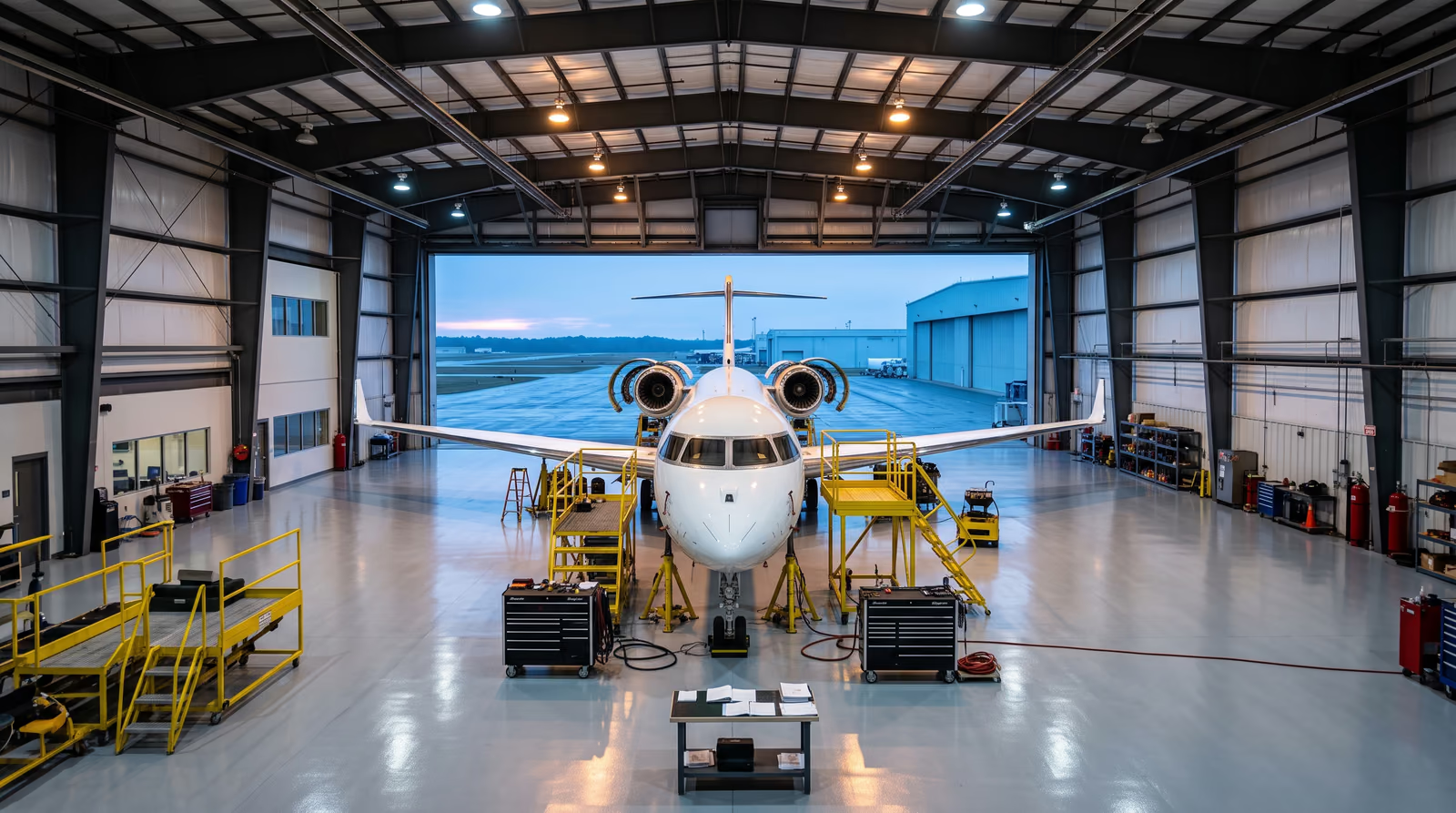
Moody's Ratings raised Bombardier's corporate family rating to Ba2 from Ba3 in mid-August 2026, kept the outlook positive, and left the company's SGL-1 speculative grade liquidity rating unchanged. Bombardier's chief financial officer, Bart Demosky, confirmed the action in a statement on 17 August, describing it as the manufacturer's second upgrade from Moody's in twelve months.
A credit rating reads as investor news and gets filed away by everyone else. That is the wrong instinct if there is a Global or a Challenger in the hangar, or a deposit sitting against a delivery slot three years out. An airframer's balance sheet decides whether money paid ahead of delivery is safe, whether the fleet keeps its value, and whether there is a service centre within range when something breaks.
The Numbers Behind the Upgrade
Moody's grounded the decision in cash generation rather than order intake. The rating agency cited an adjusted EBIT margin of 11.4% on a last twelve months basis through June 2026, against 10.1% in 2023, and expects Bombardier to generate roughly $1 billion of free cash flow in 2026. The company had repaid about $1.1 billion of net debt year to date at the time of the action.
The liquidity picture is what earns the SGL-1, the highest of Moody's four speculative grade liquidity grades and a marker of an issuer able to cover the next twelve months from internal resources without leaning on committed financing. Bombardier held about $1.5 billion of cash at 30 June 2026, alongside a $750 million revolving facility that runs to 2031, for roughly $3 billion of total liquidity against annual fixed charges of around $650 million. The company's own bond schedule shows nothing maturing before 15 November 2030.
Bombardier's second quarter results, reported on 30 July 2026, sit underneath those figures. Revenues came in at $2.15 billion, up 6% year over year on 32 aircraft deliveries, with services revenue at $674 million, up 14%. Adjusted EBITDA reached $325 million at a 15.1% margin. Backlog stood at $21.8 billion at the end of June, on a book to bill of 1.5x, and full year free cash flow guidance was raised above $1 billion.
Why a Buyer Should Care About a Rating
Most factory-new business jets are bought on a deposit schedule. Business Jet Traveler's reporting on aircraft finance makes the exposure plain: an initial deposit is followed by progress payments through the production cycle, and it is not unusual for the bulk of the purchase price to fall due well before the aircraft exists in any deliverable form. Lenders financing that stage generally want an assignment of the purchase agreement itself, because until the airframe is built there is no asset to secure the loan against.
That is unsecured credit exposure to the manufacturer, taken on for years. With Bombardier's backlog running at 1.5x book to bill, and the company guiding to more than 157 deliveries across the lineup in 2026 while working through engine and window supply constraints, the queue is measured in years rather than months for anyone ordering now. The counterparty's ability to survive that queue is not a background detail. It is the position.
The Fleet Already Flying
For existing owners the exposure runs the other way, through residual value and support. Bombardier's own recent history is the clearest illustration available. The company ended Learjet production in 2021 and delivered the final aircraft, a Learjet 75, on 28 March 2022, closing a line that had built more than 3,000 aircraft. It paired that decision with a commitment to keep the roughly 2,000 Learjets still in service flying, including the RACER remanufacturing programme for the Learjet 40 and 45. A manufacturer that can fund support for a discontinued type is a very different proposition from one that cannot, and the difference shows up in what an aircraft is worth on resale. Owners weighing that should read it alongside what a business jet actually costs to run each year, where depreciation is the single largest line in the stack.
Support capacity is being funded visibly. Bombardier's service centre at Al Bateen Executive Airport in Abu Dhabi is on track to open in the second half of 2026, adding around 100 skilled jobs and putting factory-backed maintenance inside the Gulf's private aviation cluster. A new facility at Fort Wayne International Airport of roughly 64,500 square feet is scheduled to begin operations in the same window, and in June the company committed S$100 million to nearly double its Singapore footprint at Seletar Aerospace Park by the second half of 2028. Aftermarket work is now a growth business rather than an obligation, which changes the incentive to keep older airframes serviceable at a time when used inventory sits well below its historical average.
What the Upgrade Does Not Say
Ba2 is not investment grade. It sits two notches below Baa3, the lowest rung of Moody's investment grade scale, and S&P has held Bombardier at BB- with a positive outlook since April 2026. Moody's named its constraints alongside the upgrade: the cyclicality of the business jet market, and supply chain risk carried across a dual-platform manufacturing base.
Both constraints are live. Bombardier's own second quarter commentary pointed to engine and window shortages affecting delivery timing and cost, and to a delivery profile weighted towards the fourth quarter. A company that sold its commercial aircraft and rail businesses to concentrate on business jets has no second market to fall back on if this one turns.
What the upgrade does say is that the manufacturer taking multi-year deposits is materially better capitalised than it was, is generating cash rather than consuming it, and has pushed its first meaningful debt wall out to the end of the decade. For a buyer signing a purchase agreement in 2026, that is the part of the news that has a number attached to it.