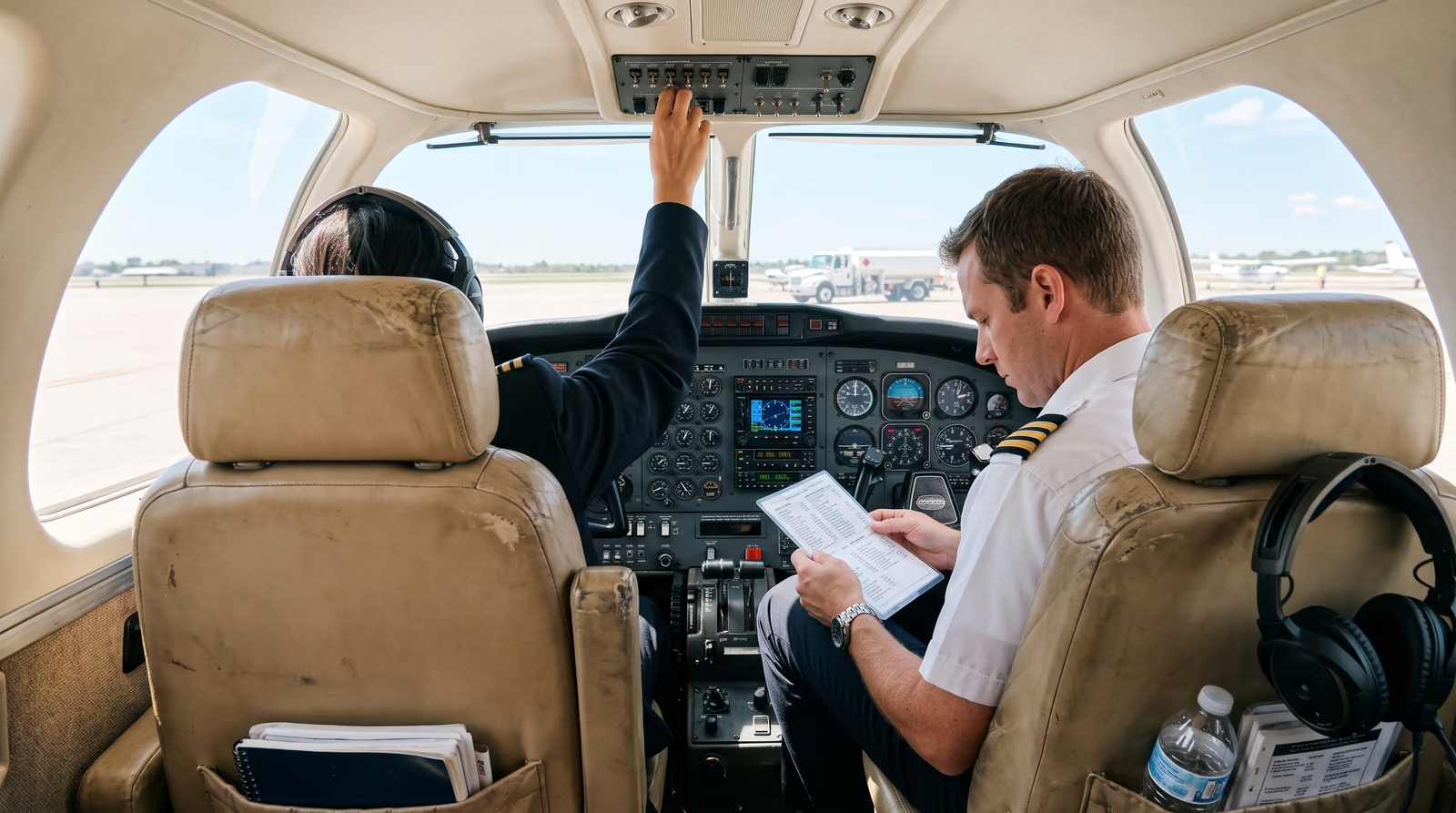
From 29 September 2026, a pilot flying a Citation II, Bravo, Ultra or Encore alone is breaking the rules. The Federal Aviation Administration has stopped issuing the single-pilot exemptions that let the older, transport category Citations be flown by one person, and is rescinding every exemption still in force. The policy was published in the Federal Register on 28 September under docket FAA-2026-12343. According to AeroTime, registry data indicate roughly 1,250 US-registered aircraft are covered.
Which Citations are covered, and which are not
The Citation 500 family was certificated two ways. The CE-500, CE-550 and CE-560 variants were certificated under Part 25 as transport category aircraft, weigh more than 12,500 pounds and are type certificated for two pilots. The FAA notice lists the models covered as the Citation and Citation I, Citation II, Citation S/II, the Model 552 (the Navy T-47A), the Citation V and Ultra, the Bravo, the Encore and the Encore+.
FAA policy effective 29 September 2026
Which Citations can still be flown by one pilot
The single-pilot exemptions covered the transport category (Part 25) Citation 500 family. Aircraft certificated for one pilot are not affected.
Two pilots required on every flight
- Citation and Citation I (Model 500)
- Citation II and Bravo (Model 550)
- Citation S/II (Model S550)
- Navy T-47A (Model 552)
- Citation V and Ultra (Model 560)
- Encore and Encore+ (Model 560)
Single pilot still permitted
- Citation Mustang (Model 510)
- CitationJet and CJ family (Model 525)
- Citation 501 and 551 (Part 23), only with the equipment the flight manual specifies
Sources: FAA notice, Federal Register, 28 September 2026 (docket FAA-2026-12343); fleet count as reported by AeroTime from registry data.
Aircraft certificated for one pilot are untouched. That includes the Citation Mustang and the CitationJet and CJ family. The Part 23 Citation 501 and 551 variants keep their single-pilot option only where they carry the additional equipment specified in the approved flight manual; without it, the notice says, they also require a second in command.
The relief never belonged to the aircraft. It was granted to training providers, who endorsed individual pilots' logbooks. The notice says those endorsements are now invalid.
Why the FAA ended a 40 year arrangement
The first exemption went to Cessna in 1984. The FAA's 2024 compliance review, prompted by organisations training pilots under another company's exemption, found incomplete records, required flight training conducted in an advanced aviation training device contrary to the exemption's conditions, and checks by designated pilot examiners that included falsified records. Of the 14 Part 61 exemption holders, 13 were denied an extension or had their exemption rescinded.
The safety case is the second leg. The FAA's review of CE-500 accidents over the past 18 years found that Part 25 variants flown by a single pilot were involved in approximately twice the rate of accidents of the Part 23 CE-500, CE-510 and CE-525 aircraft flown single pilot. That, the agency says, fails the basic test for any exemption: an equivalent level of safety.
The notice cites two accidents. One on 22 May 2025 killed six people on board and injured eight on the ground; the FAA says the pilot had received an improper check from an examiner employed by a Part 61 exemption holder six months earlier. The second, at Statesville, North Carolina on 18 December 2025, involved a two-pilot CE-500 variant flown without a qualified second in command. Both remain under NTSB investigation, and no probable cause has been determined for either.
The National Business Aviation Association said it supports the FAA acting on safety, but its senior vice president of operations, Heidi Williams, said that rescinding the exemptions in full, effective immediately and "without direct notice to affected operators, raises serious questions". NBAA and the Citation Jet Pilots association have asked the FAA to share its safety analysis.
What a second pilot costs
The owners hit hardest are owner-pilots and small operators who bought a legacy Citation because one pilot could fly it.
Under the FAA's second in command rules, a pilot serving in the right seat of an aircraft certificated for two pilots needs at least a private pilot certificate, an instrument rating for IFR flight and familiarisation training on the type. Within US airspace no type rating is required. Outside it, the second in command must hold at least an SIC-privileges pilot type rating, which matters for any N-registered Citation flying internationally, including those based in the Gulf, since FAA operating rules follow the registration.
The larger number is paying someone to sit there. CrewBlast's 2026 daily rate survey, drawn from completed contract trips, puts contract captains on light jets at $1,500 to $1,800 a day, plus per diem of $75 to $150 and positioning costs. It does not publish a separate first officer rate. Taking the captain rate as the ceiling, an owner flying 50 trip days a year would pay $75,000 to $90,000 before expenses, in AVNET's arithmetic. Against a Citation Bravo that evoJets values at $1.62 million to $1.98 million, that is roughly 4 to 6 percent of the aircraft's value, every year.
There is one saving in the notice. A pilot who completed a proficiency check under the exemption's conditions can use it to satisfy the pilot in command requirements for two-pilot operation, so the captain's own training does not have to be repeated.
What it may do to values
There is no transaction evidence yet. The mechanism is clearer. AeroGurus' model guide describes the Bravo's buyers as small businesses, partnerships and owner-pilots stepping up from turboprops, for whom one-pilot operation was part of the case. That buyer is now pointed at the CJ family and the Mustang, which keep single-pilot certification, while the Bravos and Encores sell to operators who already budget for two crew.
That lands on the oldest end of an ageing market. The Bravo left production in 2006. As AVNET reported, three quarters of the used jets for sale are now 16 years old or older, and the affected Citations sit squarely in that group.
What owners should do now
Stop flying single pilot in any covered model. Check whether a Part 23 501 or 551 carries the equipment its flight manual requires. Tell the insurer, since a policy written around one named pilot may not fit a two-pilot operation. Line up a qualified second in command, with an SIC type rating for trips abroad.
The FAA says it will apply its Compliance Program to single-pilot flights made on endorsements from providers whose exemptions were already rescinded or denied. The future of one-pilot jets, as Honeywell's DARWIN single-pilot research suggests, lies in aircraft designed for it, not in exemptions for aircraft that were not.