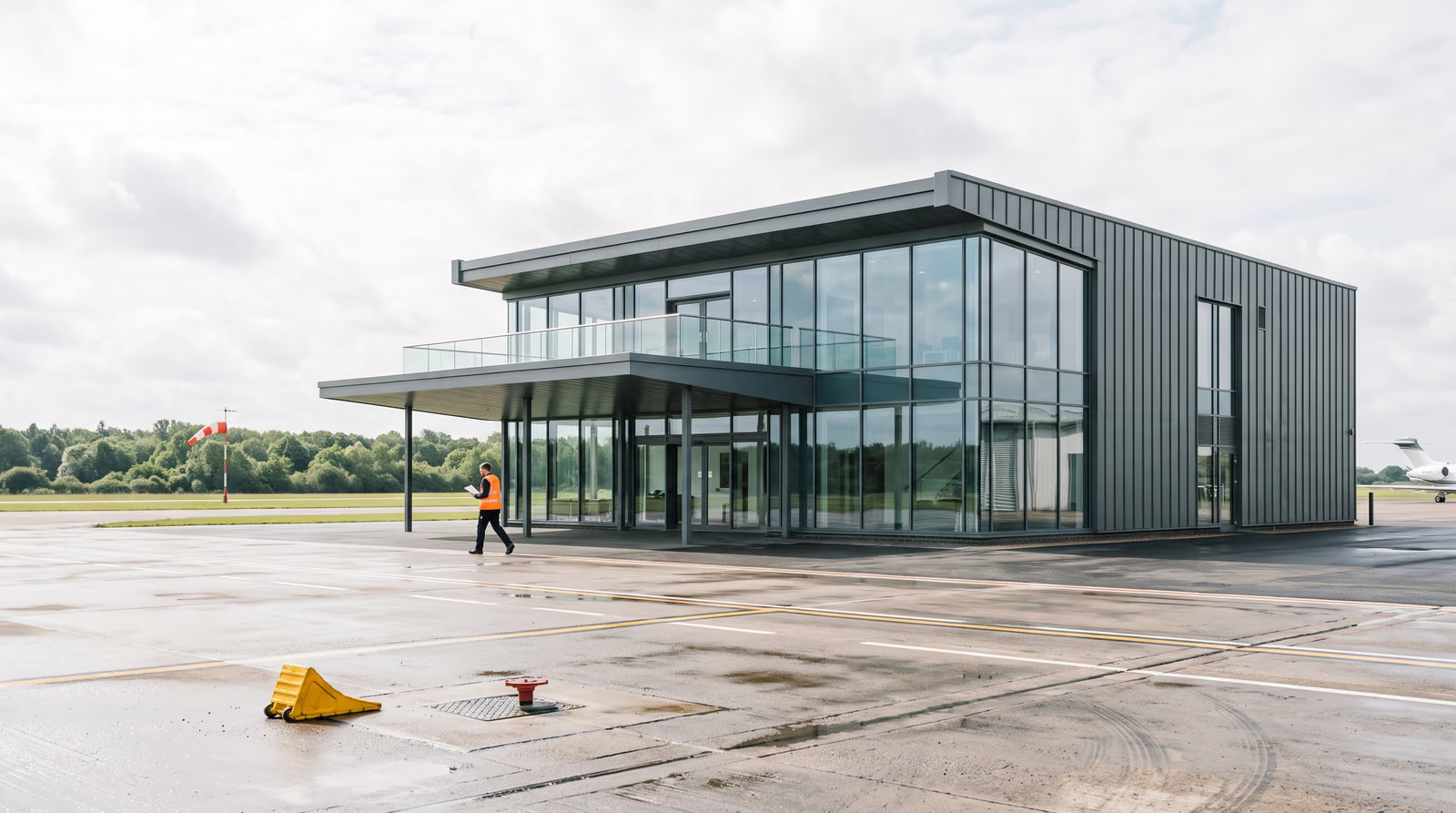
Flexjet has spent $34 million on a building at Farnborough Airport that only its own customers may use. The terminal opened on 10 September 2026, covers 2,098 square metres, or 22,580 square feet, and stands ramp side, separate from the airfield's existing main terminal. Corporate Jet Investor reports it as the first dedicated private terminal of its kind in Europe, and Flexjet says nine more are open or in development across the United States.
That is the second time in a month that the ground, rather than the aircraft, has been the asset in the news. In August, Apollo and Singapore's GIC bought into Atlantic Aviation at a valuation Bloomberg put near $10 billion, roughly twice what KKR paid in 2021 for a network half the size. Read together, the two transactions say the same thing from opposite ends of the industry. An investor is paying up to own the ramp, and an operator is building its own so it does not have to rent one.
What $34 million buys
The specification, all of it Flexjet's own, reads closer to a hotel than to a fixed base operator. The building carries dedicated security screening and immigration, private meeting rooms, an owners' bar and lounge overlooking the airfield, and a full size replica of a Gulfstream G700 cabin complete with bedroom suite. The upper floor holds the company's Tactical Control Centre and its European headquarters. An expanded Red Label Academy trains the roughly 300 cabin servers Flexjet employs globally, in kitchens built to match the ones fitted to its aircraft. On the sustainability side, 138 solar panels are forecast to generate about 37,848 kWh a year, alongside a rainwater recycling system.
Next to it sits the part that is easier to overlook. Flexjet recently opened a maintenance hangar at the same airport running to 3,530 square metres, or 37,996 square feet, which is larger than the terminal itself. Chief executive Michael Silvestro made the point explicitly, saying that nobody has the infrastructure to refurbish and maintain aircraft the way Flexjet does, and calling it the unsung hero of the company's strategy. He added that owning an aeroplane does no good if it cannot be kept flying.
Chairman Kenn Ricci framed the opening as a defining moment in the company's global expansion, and said the facility demonstrates how ownership with Flexjet extends beyond the cabin. The figures behind all of it are company supplied rather than independently audited, and should be read as such.
Flexjet at Farnborough
A $34 million building on a capped airfield
Facility figures are Flexjet's own. Movement figures are from Farnborough Airport's planning consultation material.
The ground is finite
Farnborough's annual movement limit was set at 50,000 in 2011. The airport's current application does not seek to raise it.
Sources: Flexjet company announcement and Corporate Jet Investor, 10 September 2026. Farnborough Airport consultation material.
Why Farnborough, and why a capped airfield matters
The choice of airport is not incidental. Farnborough is a business aviation field roughly an hour from central London, and it operates under a planning limit of 50,000 aircraft movements a year, granted in 2011. It is nowhere near that ceiling. The airport's own consultation material puts 2023 at 31,296 flights and 2024 at 29,702, and its current planning application does not ask to raise the 50,000 limit at all. It asks to redistribute when flights may take place, principally at weekends and on bank holidays, so the airfield can grow into the capacity it already holds by 2034.
That is the context that makes a privately owned building on that ramp worth $34 million. The number of movements Farnborough can ever sell is fixed by planning consent. The land beside those movements is not being manufactured either. An operator that owns a terminal and a hangar on a capped airfield has bought a position that cannot simply be competed away by a rival opening a bigger lounge next year, because there is a finite amount of apron to open it on.
What it changes for the person paying
For a fractional owner or a jet card holder, a captive terminal is a genuine improvement to the worst part of the trip. Dedicated security and immigration removes the queue that private flying is supposed to have removed already, and a private ramp shortens the walk. The maintenance hangar matters more than the lounge does, because an aircraft in a hangar the operator controls should come back into service faster than one waiting on a third party's schedule.
The other side of the ledger is straightforward. A building that only one operator's customers may use is only an advantage while flying with that operator, at that airport. It is a switching cost dressed as a benefit, and that is the point of building it. The open question is where the $34 million is eventually recovered. Flexjet is not short of capital to spend: an investment group led by L Catterton, the firm backed by Bernard Arnault, put $800 million of equity into the company in July 2025, at a reported valuation of about $4 billion, and Elite Traveler puts the global fleet above 350 jets and helicopters. But capital spent on the ground still has to earn a return, and the fractional market has already shown this year that prices are moving. Berkshire Hathaway's half year filing recorded a 15.5 percent rise in aviation services revenues at NetJets and named average prices among the reasons, which is as close as that market gets to an operator saying out loud that the rate has gone up.
Flexjet has not disclosed the size of its European fleet, its Farnborough movement numbers or the staffing of the new terminal, so the direct effect on an hourly rate cannot be calculated from what is public. What can be said is that the industry has started to compete on buildings. Two of the largest transactions of the past month were not aircraft orders. One was an FBO network changing hands at a ten figure valuation, and the other was an operator deciding it would rather own the terminal than be a tenant in someone else's.