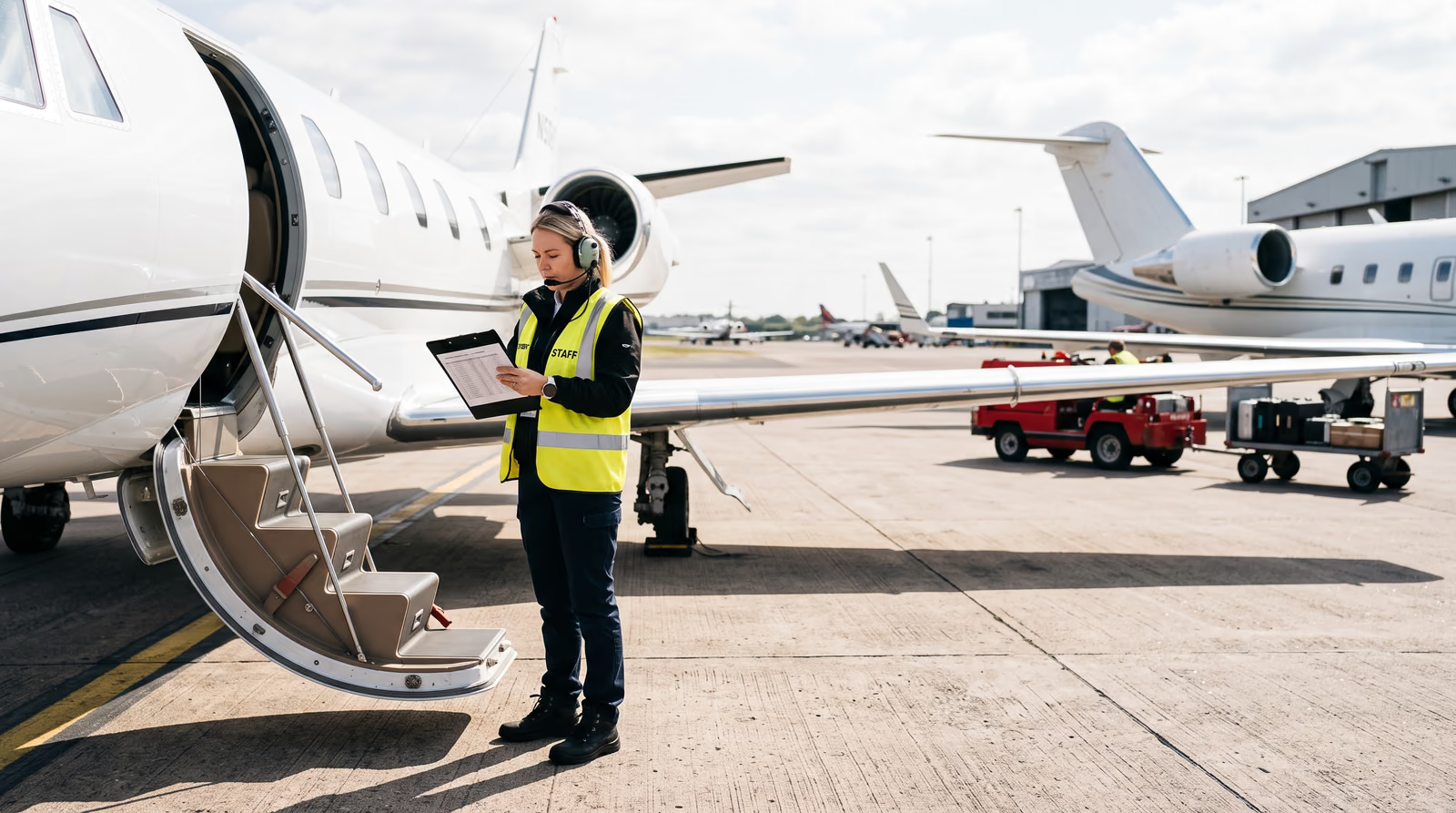
French-registered charter jets have lost between 11% and 20% of their flying in every quarter since mid 2025, while foreign-registered aircraft serving French airports grew by 3% to 4%. Those figures come from the French civil aviation authority, the DGAC, and were published on 23 September 2026 in an information report by Philippe Juvin, general rapporteur of the National Assembly's finance committee. The foreign share of the French business aviation market has risen from 86% at the start of 2025 to 91% by mid 2026.
The cause the report identifies is a tax. The more useful question for an owner outside France is how a levy on every operator landed on only some of them.
What the tax is
The solidarity tax on air tickets, known in France as the TSBA, was sharply increased by the 2025 finance law and took effect on 1 March 2025. For airline passengers the rise was modest: an economy seat to a European destination went from 2.63 to 7.40 euros.
Business aviation was treated very differently. Before the change, a charter passenger paid the same small amounts as an airline passenger, between 2.63 and 7.51 euros. The law created separate business aviation bands for non-scheduled flights on aircraft of 19 seats or fewer, and the current rates in the French transport tax code are:
- Turbojet aircraft: 420 euros per passenger to a European destination, 1,015 euros to an intermediate destination and 2,100 euros to a long-haul destination more than 5,500 km from Paris.
- Turboprop aircraft: 210, 675 and 1,025 euros for the same three bands.
Eight passengers on a long-haul departure from Le Bourget owe 16,800 euros. Charles Aguettant, president of EBAA France, told the Journal du Dimanche in March 2025 that the levy had been multiplied by 700 and that it represents around 2% of an airline fare but between 10% and 100% of the price of a business aviation trip.
What happened to the flying
The report's quarterly series is stark. According to the DGAC data it cites, French-registered business aviation traffic, measured against the same quarter a year earlier, fell:
- 20% in the third quarter of 2025
- 14% in the fourth quarter of 2025
- 20% in the first quarter of 2026
- 11% in the second quarter of 2026
Over the same period, traffic by foreign-registered aircraft rose by 3% to 4%. The report notes that "certain French companies changed flag, while others saw their activity fall, or even had to stop it." French operators already accounted for only around 10% of business aviation movements in France, so the loss came out of a small base.
The Tax Landed on the Flag
Since France raised its air ticket tax on business aviation, French-registered operators have shrunk every quarter while foreign-registered aircraft took more of the market.
91%
Foreign-registered share of French business aviation traffic by mid 2026, up from 86%
+3 to 4%
Growth in foreign-registered traffic since the third quarter of 2025
EUR 42.6m
Raised from business aircraft in 2025, under 4% of the tax's EUR 1.151bn total
French-registered traffic, change on a year earlier
Business aviation movements by French-registered operators, DGAC data.
Tax per passenger departing France
Before 1 March 2025 a charter passenger paid the airline rate of 2.63 to 7.51 euros. Mid range covers non-European destinations within 5,500 km of Paris.
| Flying to | Airline economy | Charter turbo-prop | Charter jet |
|---|---|---|---|
| Europe | EUR 7.40 | EUR 210 | EUR 420 |
| Mid range | EUR 15 | EUR 675 | EUR 1,015 |
| Long haul (5,500 km+) | EUR 40 | EUR 1,025 | EUR 2,100 |
Sources: French National Assembly finance committee information report no. 3189 (Philippe Juvin, 23 September 2026), citing DGAC traffic and revenue data; French transport tax code, article L. 422-22.
The market did not collapse. France still hosts what the report calls Europe's two leading business aviation airports, Le Bourget and Nice, and passengers kept flying there. They increasingly did it on foreign-registered aircraft, against the broader picture of a record but slowing summer for business jet flying.
Why a universal tax fell on one flag
On paper the TSBA applies to every commercial passenger boarding in France, whatever the registration of the aircraft. In practice it is a declarative tax: the operator calculates and declares what it owes.
EBAA France set out the consequence in a statement on 4 November 2025. Because the tax is declarative, it said, French operators carry most of it while foreign companies "visibly escape it in large part". The association said around 150 million euros had been expected from business aviation and only a few tens of millions had been collected.
The government's own figures in the Juvin report point the same way. Of the 1.151 billion euros the tax raised in 2025, business jets accounted for 41.4 million euros and business turboprops for 1.2 million, together less than 4% of the total. For a segment taxed at up to 2,100 euros a head, that is a small yield, and it is consistent with a tax that is being paid in full by the 10% of the market that is French and only partly by the 90% that is not.
The report's conclusion is blunt. The tax treatment of business aviation "seems to be causing very damaging consequences, for a very limited benefit to public finances."
What it means for owners and charter clients
A tax enforced most effectively on domestic operators moves the work to another registry rather than reducing it. Aircraft are mobile, and charter clients rarely ask which country is printed on the tail.
For a Gulf-based owner whose aircraft is managed on a European or Gulf certificate and flies charter into Nice or Le Bourget, three practical points follow:
- The liability exists regardless of flag. A foreign operator carrying commercial passengers out of France owes the TSBA. A low quote that does not mention it is not a saving. It is a liability the operator may not be accounting for, and a client should know whether the price includes it.
- Ask for the tax as a separate line. Reputable operators itemise passenger taxes. On a long-haul departure the TSBA alone can be larger than the positioning cost, which makes it worth checking against the real cost of chartering a private jet.
- Enforcement is the variable to watch. EBAA France's central demand is equal collection from all operators, not only a lower rate. If France closes the collection gap, the price advantage of foreign-registered aircraft on French departures narrows overnight.
What comes next
The 2027 French budget is being debated this autumn. EBAA France has asked for the business aviation rate to be brought into line with first and business class airline fares, for collection to be made equal across operators, and for the revenue to be directed to decarbonising the sector.
Whether the budget acts on the Juvin report will decide if the French flag in business aviation shrinks further or stabilises at the 9% of its own market it holds today.