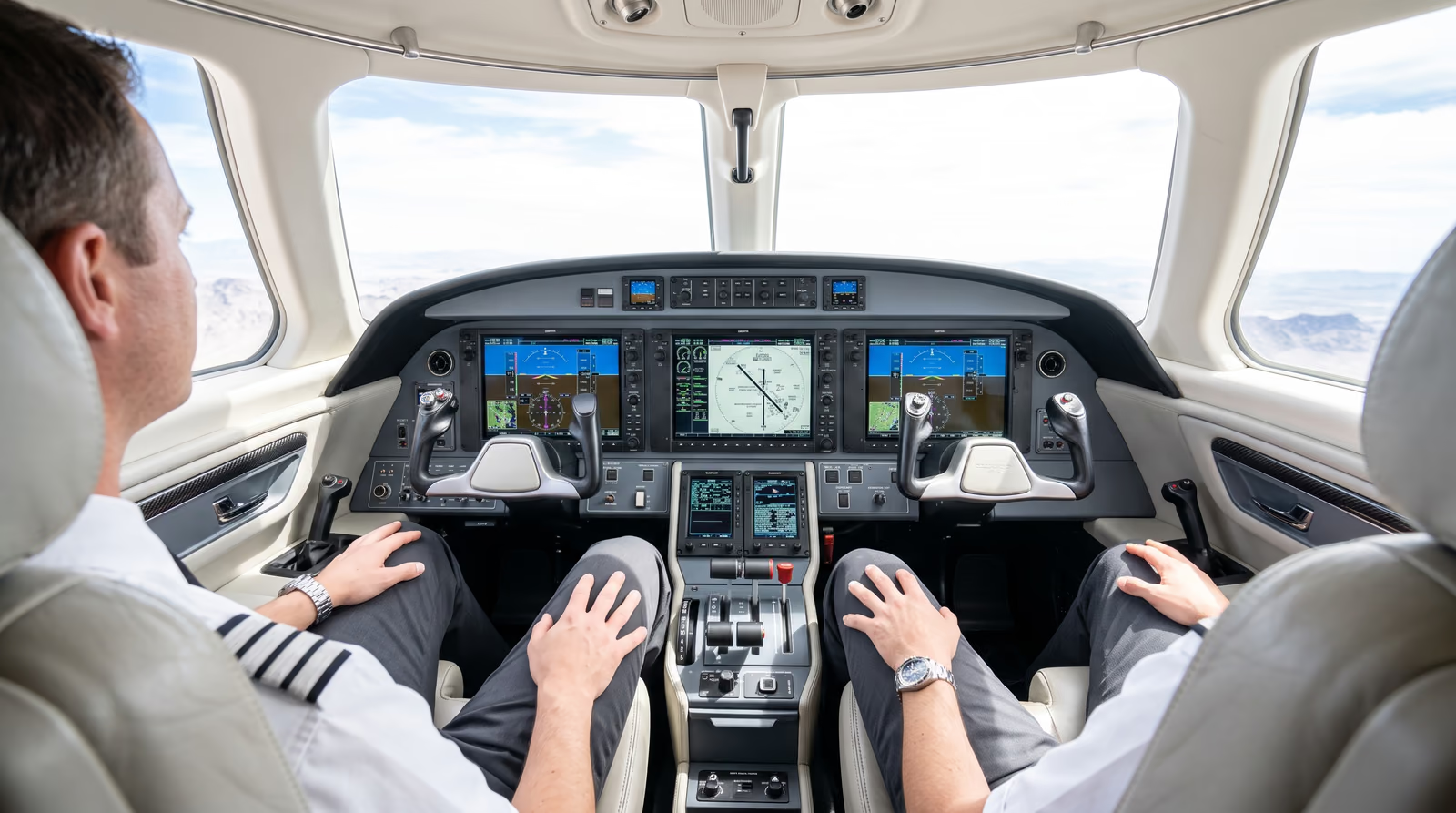
Embraer's Phenom 300EV was certified simultaneously by Brazil's ANAC, the United States FAA and EASA on 25 August 2026, making it the first light jet approved with Garmin Emergency Autoland. The technology itself is not new. It has been flying on certified aircraft since 2020. What is new is the size and complexity of the aeroplane it has finally been cleared to fly.
Emergency Autoland is a system that lands the aircraft when the pilot cannot. It activates either automatically, when the avionics detect that the pilot has stopped responding, or manually, when a passenger presses a button. From there it selects an airport and runway against weather, terrain, fuel remaining and runway length, broadcasts the aircraft's intentions to air traffic control, flies the approach, lands and brings the aircraft to a stop. Nobody in the cabin has to do anything else.
Six Years From a Single Engine Turboprop to a Light Twin
Garmin first certified Emergency Autoland in 2020, on three aircraft: the Piper M600, the Daher TBM 940 and the Cirrus SF50 Vision Jet. The Beechcraft King Air 260 followed in 2022, and in August 2025 Garmin obtained FAA approval to retrofit Autoland and Autothrottle into selected G1000 NXi equipped King Air 350s. Cirrus then extended its Safe Return version of the system to the piston powered SR series.
Read as a list, that is a system moving steadily up the general aviation fleet. Read another way, it is a system that spent six years on single engine aircraft and light turboprops before reaching a twin engine jet. The Phenom 300EV is now the largest business jet certified with it.
The gap matters because the problem gets harder as the aircraft gets more capable. An automated landing system has to manage thrust, configuration changes, braking and directional control on the runway, and each becomes harder on a twin flying at Mach 0.80 with a considerably higher approach speed than a TBM. Embraer's answer was to build the control architecture rather than bolt the system on. The aircraft carries an Embraer designed Multi-Purpose Electronic Controller that enables electronically controlled autobrake and rudder-by-wire, which is what allows an automated system to steer and stop the aircraft after touchdown.
Six Years Up the Fleet
Every aircraft certified with Garmin Emergency Autoland, in the order it was approved. The system spent six years on single engine aircraft and light turboprops before it reached a twin engine jet.
What Else Changed on the EV
Autoland is the headline, but it arrives inside a broader avionics rework. The EV runs a Garmin G3000 based Prodigy Touch flight deck with autothrottle, Emergency Descent Mode and a Runway Overrun Awareness and Alerting System. Embraer quotes roughly 430 pounds of additional payload over the outgoing model, and range of 2,055 nautical miles with four passengers and NBAA IFR reserves at a maximum speed of Mach 0.80.
In the cabin, the EV adds low Earth orbit satellite connectivity as a standard line fit item through Gogo Galileo, with Starlink available afterwards as a retrofit under a Supplemental Type Certificate. Revised temperature management, an air ionisation system and a vacuum lavatory are new, and the maximum cabin altitude stays at 6,600 feet.
The range figure is the one worth holding onto. At 2,055 nautical miles the aircraft opens sectors that were awkward in this class, and Embraer's own marketing reaches for two of them: Aspen to New York, and Dubai to the Maldives. For a Gulf based owner that second example is the point of the aeroplane. It puts a common leisure sector inside a light jet's legs rather than requiring a midsize cabin to do it.
The Best Selling Claim Needs a Qualifier
Embraer markets the Phenom 300 series as the world's best selling light jet for 14 consecutive years and the most delivered twin engine jet for six, both citing GAMA data. The company delivered 72 Phenom 300 series aircraft in 2025, its strongest year of the decade, and reports more than 900 in service across 70 countries with over 2.9 million flight hours accumulated.
Both claims are accurate as stated, and both are category dependent. GAMA's 2025 numbers show Cirrus delivering 106 SF50 Vision Jets against those 72 Phenoms, which made the Vision Jet the most delivered business jet in the world for a sixth straight year. The Vision Jet is a single engine aircraft and is usually counted in a different segment, which is exactly why Embraer's own phrasing carries the twin engine qualifier. The Phenom leads its class. It does not lead the delivery table.
There is a second irony in the certification. The Vision Jet has carried Emergency Autoland since 2020. The most delivered business jet in the world got the technology six years before the best selling light jet did.
What It Does Not Change
Two things are worth keeping straight. First, the calendar. First deliveries are expected in 2028, so nothing about this certification alters what a buyer can order and take this year. The nearer term competitive question in this segment remains the one covered when the 500th Citation CJ4 shipped while the Gen3 waited on FAA certification, which is about aircraft entering service now rather than at the end of the decade.
Second, and more often confused, Emergency Autoland is not a step toward flying the aircraft with one pilot instead of two. It is a passenger survivability backstop for the case where the flight crew is incapacitated, and it makes no claim to reduce the crew complement on a normal flight. The work aimed at genuinely reducing crew requirements is a separate and considerably less mature effort, of the kind Honeywell has been pursuing with its DARWIN project, and it faces regulatory questions that an emergency-only system does not have to answer.
What the certification does establish is a precedent. A regulator in Brazil, the United States and Europe has now agreed, on the same day, that an automated system may land a twin engine jet of this size unaided. Everything above the Phenom 300 in the cabin range is now a question of engineering effort rather than of whether the concept is certifiable at all.