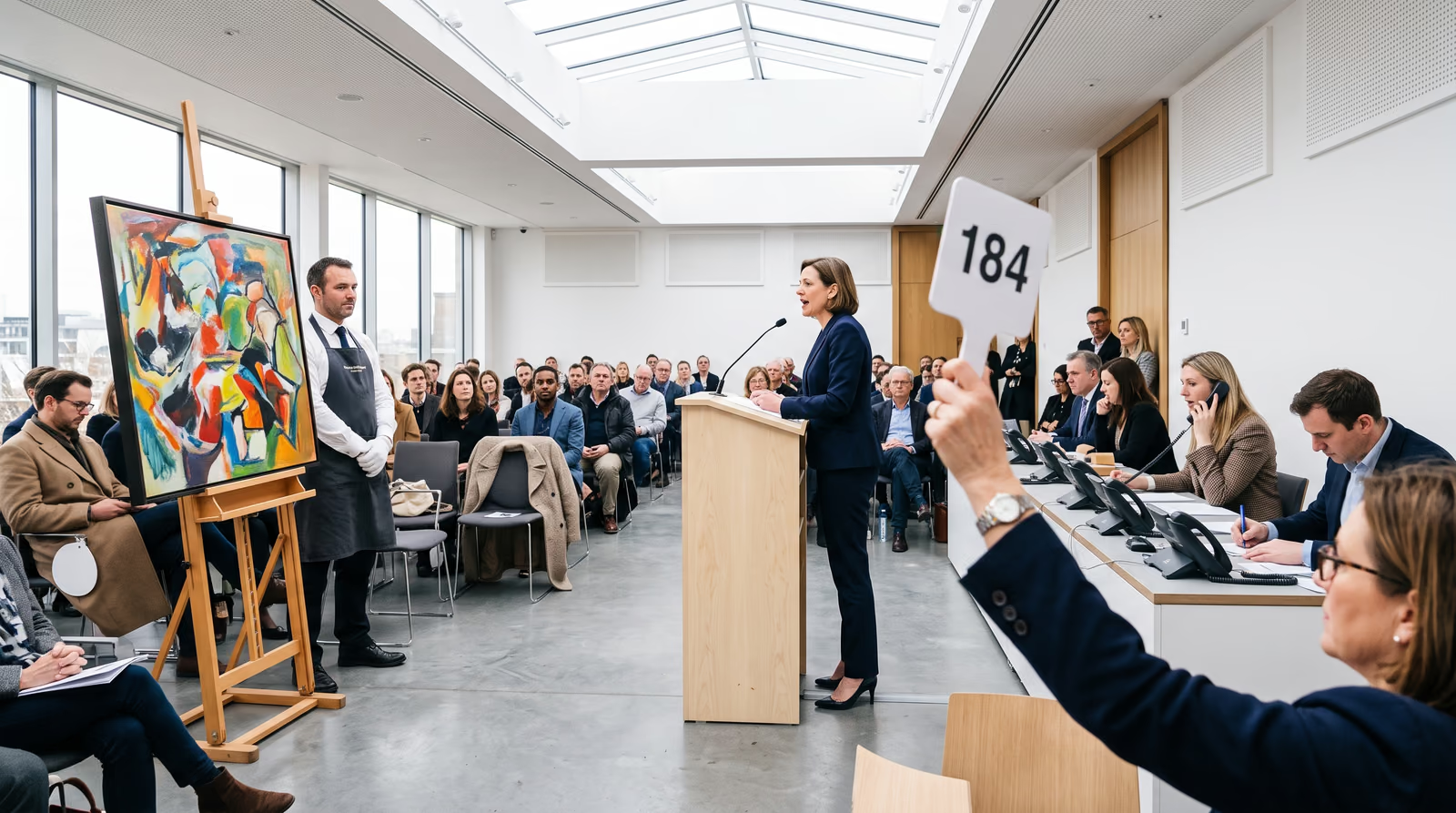
A painting that sells for £1,000,000 in a London saleroom costs the buyer about £1,346,000. The same hammer price in New York, collected in the city, costs about $1,393,600. The auctioneer calls one number and the invoice carries another, roughly 35 percent higher in London and 39 percent higher in New York, before shipping, storage or insurance.
Almost all of the gap is the buyer's premium, the fee the house adds to the hammer price. The rest is tax and, in London, a royalty paid to the artist. Every rate below is taken from the house's own published schedule and dated, because the schedules change often: four of the five major houses have moved their rates in the past thirteen months. The totals are AVNET's arithmetic on those published rates. None of this is tax advice, and the houses themselves tell buyers to take their own.
Five ladders, and two of them are identical
Buyer's premiums are charged in tiers that fall as the hammer price rises. The rates for general sales at the five houses a collector is most likely to bid with:
| House | Schedule dated | Rates, London | Break points, London |
|---|---|---|---|
| Christie's | 1 September 2026 | 28% / 22% / 15% | £1.5m, £6m |
| Sotheby's | 9 September 2026 | 28% / 22% / 15% | £1.5m, £6m |
| Phillips, standard | 12 April 2026 | 29% / 22% / 15% | £1.5m, £6m |
| Phillips, Priority Bidding | 12 April 2026 | 25% / 20% / 14% | £1.5m, £6m |
| Bonhams | 1 October 2026 | 30% / 28% / 25% / 21% / 14% | £25k, £500k, £1m, £5m |
Christie's and Sotheby's now charge the same rate at every tier, at the same break points, in every currency they sell in. Many buyers assume the two compete on fees. On published schedules they do not. In US dollars both use breaks at $2,000,000 and $8,000,000, and Sotheby's lists the United Arab Emirates as a dollar saleroom alongside New York and Saudi Arabia. Christie's Dubai terms, effective 1 September 2026, carry the same dollar ladder.
Phillips runs two tracks. Its standard rate opens at 29 percent, a point above the other two, while bidders who meet the conditions of its Priority Bidding programme pay 25, 20 and 14 percent. Watches have their own lower ladder with no priority track: 27, 21 and 14.5 percent in New York, Geneva and Hong Kong, relevant for a category whose trade AVNET follows in the Swiss watch export figures. Phillips is also the only house that publishes its London rates with VAT included, and the top figure on that page is 34.8 percent.
Bonhams changes both its UK and US schedules on 1 October 2026. In London the entry rate rises from 28 percent to 30 percent, charged on the first £25,000, with 28 percent to £500,000, 25 percent to £1,000,000, 21 percent to £5,000,000 and 14 percent above. The US schedule follows the same shape, with 30 percent on the first $35,000. At 30 percent, Bonhams now has the highest entry rate of the five.
The mechanism differs as well as the rate. Bonhams charges in true bands, so a large lot pays 30 percent only on the first slice. Christie's and Sotheby's charge 28 percent on the whole hammer up to the first break, so a £1,400,000 lot pays 28 percent on every pound of it.
What stacks on top of the premium
VAT on the premium. In London, 20 percent VAT is added to the buyer's premium. A non-UK buyer who exports the lot within three months can reclaim it, subject to a minimum of £50 per shipment and a £20 processing charge, according to Sotheby's buyer tax guide. Artworks imported into the UK for sale can attract import VAT at an effective rate of 5 percent under HMRC's rules for works of art.
The artist's resale royalty. When a living artist's work, or one by an artist who died within the past 70 years, resells in the UK for £1,000 or more, a royalty is due. Under the bands published by the UK government, it is 4 percent of the price up to £50,000, then 3, 1, 0.5 and 0.25 percent in higher bands, capped at £12,500 per work. On a £1,000,000 lot it comes to £10,000. Christie's London conditions of sale put it squarely on the buyer: "you must pay us an extra amount equal to the royalty." VAT is charged on the premium but not on the royalty. Who bears it depends on the house, however. Bonhams' conditions put any shortfall in collecting the royalty back on the seller.
US sales tax. Sotheby's guide, updated 13 September 2026, sets New York City sales tax at 8.875 percent, charged on the hammer price, the buyer's premium and other charges when the lot is collected or delivered in New York. The house is registered to collect in 44 states and the District of Columbia.
Dubai. Christie's Dubai terms mark imported lots with an asterisk. On those, a buyer collecting in Dubai pays 5 percent import duty on the hammer price and 5 percent import VAT on the duty-inclusive hammer, plus 5 percent VAT on the premium. On a $500,000 lot, the all-in total works out at 39.65 percent above hammer. A non-resident who exports the lot outside the UAE within 90 days can have the VAT refunded under the same terms. There are some unusual extras too. Christie's London terms list Jersey GST at 5 percent for lots delivered there, and a 2 percent Indian equalisation levy for online bidders with a registered Indian address.
Put together on a £1,000,000 London art lot with the royalty due, the premium, its VAT and the royalty come to:
| House | Premium | All-in above hammer |
|---|---|---|
| Christie's | £280,000 | 34.60% |
| Sotheby's | £280,000 | 34.60% |
| Phillips, standard | £290,000 | 35.80% |
| Phillips, Priority Bidding | £250,000 | 31.00% |
| Bonhams, to 30 September | £258,400 | 32.01% |
| Bonhams, from 1 October | £265,500 | 32.86% |
The same $1,000,000 lot collected in New York City, with sales tax on hammer and premium, comes to 39.36 percent at Christie's and Sotheby's, 40.45 percent at Phillips standard rates, 38.27 percent on the Phillips watch ladder and 38.62 percent at Bonhams under its October schedule.
What a one million lot really costs the buyer
All-in cost above the hammer price, general art sales, by house. Computed by AVNET from each house's published schedule.
London, £1,000,000 lot
New York, $1,000,000 lot collected in the city
Dubai, collected in Dubai
The bigger the lot, the lower the rate
Effective buyer's premium on the Christie's and Sotheby's dollar ladder, premium only.
London includes 20% VAT on the premium and a £10,000 artist's resale royalty. New York includes 8.875% city sales tax on hammer and premium. Dubai includes 5% import duty, 5% import VAT and 5% VAT on the premium for an imported lot. Schedules: Christie's 1 September 2026, Sotheby's 9 September 2026, Phillips 12 April 2026, Bonhams 1 October 2026. Sources: the houses' published buyer's premium schedules and conditions of sale, UK government, Sotheby's buyer tax guide.
Where the premium stops hurting
The tiers mean the effective rate falls as the lot gets bigger. On the Christie's and Sotheby's dollar ladder, premium only:
| Hammer price | Premium | Effective rate |
|---|---|---|
| $100,000 | $28,000 | 28.00% |
| $1,000,000 | $280,000 | 28.00% |
| $2,000,000 | $560,000 | 28.00% |
| $5,000,000 | $1,220,000 | 24.40% |
| $10,000,000 | $2,180,000 | 21.80% |
| $50,000,000 | $8,180,000 | 16.36% |
A buyer at $100,000 pays 28 percent. A buyer at $50,000,000 pays a little over 16. In rate terms, the smaller buyer is paying more for the same service than the trophy buyer. This fits with AVNET's report on how a small number of lots now make most of the auction market's money: the lots that bring in most of the value are also the ones charged the lowest rate.
Collector cars sit on a different scale altogether. RM Sotheby's does not publish one global schedule and sets rates sale by sale. At its Monterey 2026 sale, cars carried 12 percent to $250,000 and 10 percent above, so a $1,000,000 car paid a $105,000 premium, 10.5 percent. At its Woodcote Park 2026 sale in England, the rate was 15 percent to £200,000 and 12.5 percent above, plus VAT, which is 15.6 percent on a £1,000,000 car. That is less than half the art rate, and one reason the record week at Monterey drew the money it did. Woodcote Park also publishes the ancillary charges most sales leave vague: £550 plus VAT to move a car to storage, £30 plus VAT a day in storage, and £400 plus VAT per lot for temporary import bond administration.
Guarantees: what the published price may not tell you
A growing share of top lots is guaranteed before the sale, either by the house or by a third party who commits to buy at an agreed level. According to the Bank of America and ArtTactic auction review of March 2026, 78 percent of the value of New York evening sales in 2025 was guaranteed, the highest share in a decade.
The houses' own terms explain what that does to a result. Sotheby's catalogue guide says that when an irrevocable bidder wins the lot, any fee paid to that bidder may be netted against the price, and "the purchase price reported for the lot shall be net of any such fees." Christie's describes the third-party guarantor as committed to buying the lot "even if there are no other bids", and notes that it may enter other financial arrangements that "are not marked with a symbol." Phillips' London conditions allow a guaranteed lot's reserve to be set at the irrevocable bid.
For a bidder, this means a guaranteed lot with no competing bid is in effect a sale agreed in advance, and the published price may be a figure net of fees. In New York these symbols are house policy rather than law. According to a June 2022 analysis by the law firm Hunton, the city's rule changes that year removed the requirement for auctioneers to disclose reserves and their own financial interest in lots.
The round trip
The premium is only half the cost. Sellers pay a commission too, and here the houses are far less open. Four of the five do not publish a general seller's commission rate. It is agreed privately in each consignment contract. The exception is Sotheby's, whose published standard seller's commission is 10 percent of the hammer price, with a $500 minimum on lots estimated at $5,000 or less, sold or unsold. Bonhams' seller terms add a 1.5 percent loss and damage warranty fee, charged whether the lot sells or not, and a withdrawal fee that rises to 100 percent of the commission and buyer's premium the lot would have earned if it is pulled late.
Taken as a scenario on those published rates: a London buyer who is £1,346,000 in on a £1,000,000 hammer needs the next hammer to reach about £1,495,556 to break even after a 10 percent commission, and about £1,520,904 once a 1.5 percent warranty fee is added. A collectible bought and resold through the salerooms has to rise roughly 50 percent in value before its owner is back where they started.
What the premium does buy is written into the same terms. Christie's gives an authenticity warranty that runs for five years from the date of the sale, covering the information printed in capitals in the first line of the catalogue entry. For a buyer paying 35 percent above the hammer price, that is the part of the premium to read before bidding.