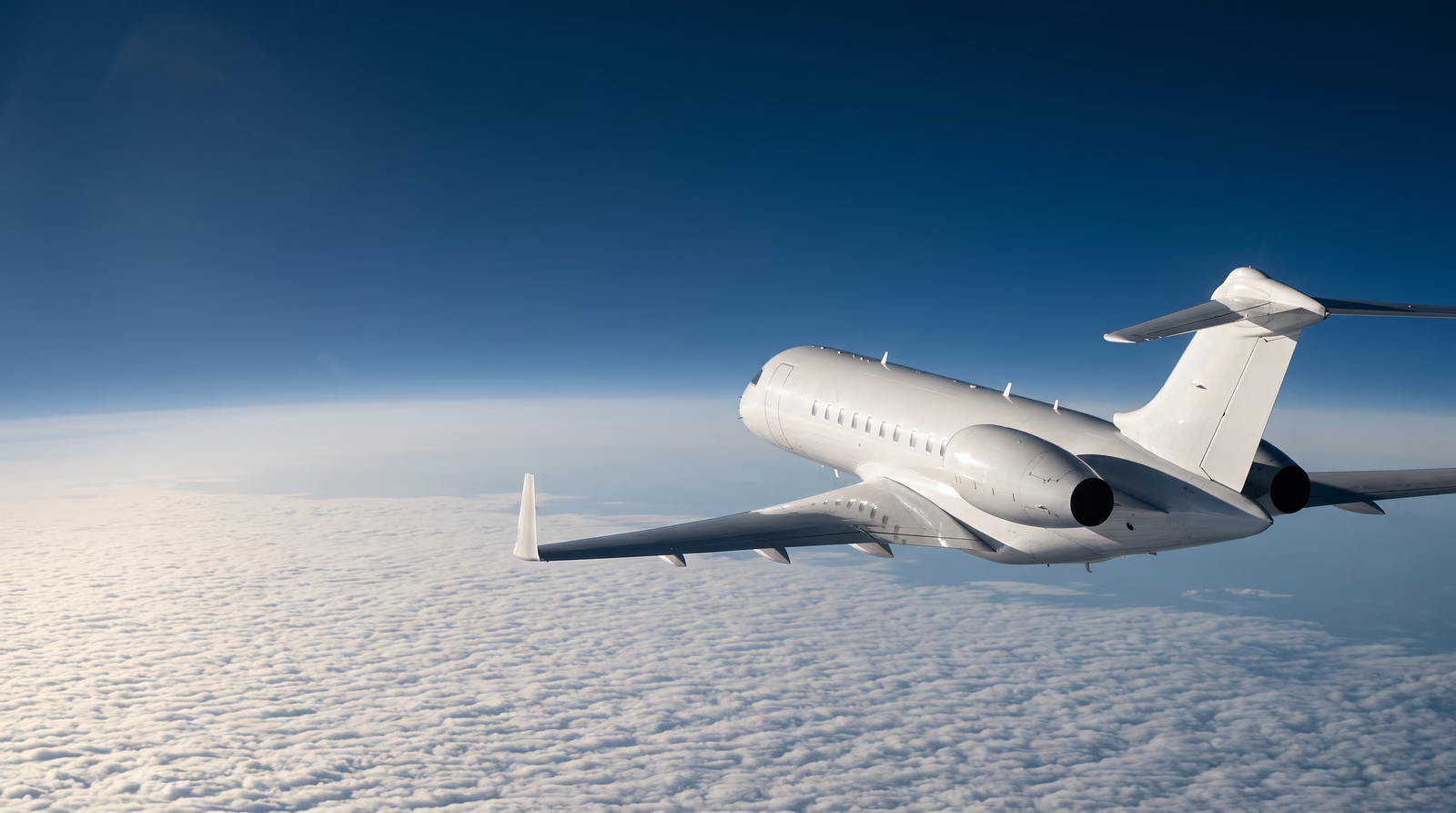
Gulfstream's G800 was certified in April 2025 with a range of 8,200 nautical miles at Mach 0.85. The busiest private Atlantic crossing in the world, Teterboro to Farnborough, is 2,986 nautical miles measured great circle. The flagship carries roughly two and a half times the range that route needs.
That gap is the whole story of transatlantic jet selection. Almost every aircraft sold as a long-range business jet can cross the Atlantic in one direction, in good conditions, with a light load. Far fewer can do it westbound in January with ten people and their luggage on board. The right question is never "which jet has the longest range", it is "which crossing, in which direction, in which season, with how many passengers".
What a range figure on a spec sheet actually means
Manufacturers quote range under the NBAA IFR standard, which the National Business Aviation Association created so that competing aircraft could be compared on the same basis. The profile assumes four passengers, still air, a climb to optimum cruise altitude, and enough reserve fuel for a missed approach, a five minute hold, and a diversion to an alternate airport 200 nautical miles away.
Every one of those assumptions is generous. Four passengers is not a full cabin. Still air does not exist over the North Atlantic. The number on the brochure is a ceiling under laboratory conditions, not a schedule you can plan a winter season around.
Add real passengers and real weather and the picture changes quickly. Industry flight planning guidance puts the penalty of a 50 knot headwind at 10 to 15 percent of effective range. Fuel reserves alone typically consume 30 to 45 minutes of the advertised flying time.
Westbound is the expensive direction
The North Atlantic jet stream runs west to east, which means an eastbound crossing gets a push and a westbound crossing pays for it. The same airframe that flies London to New York nonstop in August may need a fuel stop on the same route in January.
The stops are well established. Teterboro to Keflavik is 2,245 nautical miles. St John's in Newfoundland to Farnborough is 1,998. Both sit comfortably inside the range of aircraft that cannot make the full crossing, which is exactly why they exist as tech stops. A fuel stop is not a failure, but it adds an hour and a half of ground time and it changes the arithmetic of chartering an aircraft one class down.
The crossings are shorter than the aircraft
Great circle distance of the routes private flyers actually fly, set against the published range of the jets sold to fly them. Both groups share one scale, from zero to 8,200 nautical miles.
The crossings, great circle
The aircraft, published range
Read it this way. Every aircraft from the Falcon 8X upward clears every Atlantic crossing on the list with room to spare. The published figures assume NBAA IFR reserves, four passengers and still air, so a westbound leg into a winter headwind can cost 10 to 15 percent of the bar you see here.
Range figures as published by Gulfstream, Bombardier, Dassault and Embraer, 2026. Distances calculated great circle between airport pairs, before routing and air traffic constraints. All figures in nautical miles.
Super midsize: the Praetor 600 is the only one that seriously tries
Embraer quotes 4,018 nautical miles for the Praetor 600 under NBAA IFR reserves with four passengers, powered by two Honeywell HTF7500E engines. It is the only super midsize jet marketed as capable of a nonstop New York to London crossing, and on the eastbound leg with a modest load it does the job.
Its nearest competitor does not pretend. The Bombardier Challenger 3500 carries roughly 3,400 nautical miles of range, which covers Reykjavik to New York and short northern routings but leaves most transatlantic city pairs needing a stop.
The honest framing for the Praetor 600 is this: it is a genuine transatlantic aircraft eastbound, and a conditional one westbound. Buyers who cross a few times a year and are relaxed about a Keflavik stop in winter get large cabin capability at super midsize running costs. Buyers who need the crossing to be reliable in both directions, every month, should be shopping a class up.
Large cabin: where most crossings are actually flown
This is the segment that does the work. The Gulfstream G650ER carries 7,500 nautical miles and has the deepest installed fleet in the category, with more than 500 G650 and G650ER aircraft in service between them. For anyone chartering rather than owning, fleet size is a practical advantage: more aircraft means better availability and more competitive positioning, a point that matters as much as any performance figure.
The Bombardier Global 7500 answers it at 7,700 nautical miles, and Bombardier has been delivering the type in volume since it passed its 150th delivery. Dassault covers the segment with the trijet Falcon 8X at 6,450 nautical miles and the newer Falcon 6X at 5,500.
Every aircraft in this group crosses the Atlantic nonstop in both directions on essentially any city pair a private flyer will realistically fly, in any season, with a full cabin. That is the point at which range stops being the constraint and cabin, availability and cost take over.
The flagships: range that no Atlantic crossing requires
The top of the market has moved a long way past what the Atlantic demands.
The Gulfstream G700 received FAA certification in March 2024 and EASA certification in May 2024 at 7,750 nautical miles at Mach 0.85, or 6,650 at Mach 0.90, with the longest cabin in business aviation at 56 feet 11 inches. The G800 followed with FAA and EASA certification on 16 April 2025 at 8,200 nautical miles at Mach 0.85, 8,000 at Mach 0.87 and 7,000 at Mach 0.90, figures that came in 200 nautical miles above Gulfstream's original projections, with first customer delivery in September 2025.
Bombardier answered with the Global 8000, which took Transport Canada type certification in November 2025 and entered service that December, quoting 8,000 nautical miles, a top speed of Mach 0.95 that makes it the fastest civil aircraft since Concorde, and a cabin altitude of 2,691 feet at 41,000 feet. FAA and EASA approvals are expected during 2026.
Dassault's entry, the Falcon 10X, is quoted at 7,500 nautical miles on Rolls-Royce Pearl 10X engines, but it is not arriving until 2027 after a series of schedule slips.
On a 2,986 nautical mile crossing, none of that extra range is doing anything. What the flagships actually sell on the Atlantic is speed, cabin volume and cabin altitude. The speed advantage is real but modest: a Mach 0.05 difference in cruise changes a New York to London leg by roughly twenty minutes, not by hours. The cabin is where the money goes, and on a six hour overnight the cabin is what passengers remember.
What the crossing costs
Charter pricing for ultra long range aircraft in 2026 sits in a broad band. Market rate guides put the Gulfstream G650ER at around $13,000 per hour on average, with the ultra long range category generally quoted between $10,000 and $15,000 per hour depending on aircraft age, configuration and routing.
The hourly figure is the beginning of the bill, not the end. Positioning flights, landing and handling charges, crew expenses, international fees, catering and taxes typically add 25 to 40 percent on top of a straight hourly calculation. A six hour eastbound leg quoted at $13,000 per hour is not a $78,000 trip. Our guide to what chartering a private jet actually costs breaks down where the rest of the money goes.
The market is not buying range the way the manufacturers are selling it
Flight activity data suggests the range race at the top of the market is running ahead of demand at the large cabin end. Argus Analytics TraqPak recorded global business aviation activity up 5.6 percent year over year in July 2026, but Europe fell 1.2 percent, its first annual contraction in 14 months, driven by a 6.5 percent drop in European large cabin jet flights. North American large cabin fractional operations, by contrast, grew 20.4 percent.
The pattern is consistent: growth is coming from programmes that sell guaranteed availability rather than from owners buying maximum range. For a flyer crossing the Atlantic six times a year, availability on the day is worth more than 500 nautical miles of range that will never be used.
Matching the aircraft to the crossing
The distances decide it, and they are not close calls.
East coast United States to western Europe runs under 3,200 nautical miles. Teterboro to Farnborough is 2,986 and Teterboro to Le Bourget is 3,150. A Praetor 600 covers this eastbound; a large cabin type removes the winter westbound question entirely.
West coast to Europe changes the class requirement. Van Nuys to Farnborough is 4,718 nautical miles and Los Angeles to London is 4,730. Miami to Geneva is 4,161 and São Paulo to London is 5,123. These are large cabin missions: G650ER, Global 7500 or Falcon 8X as the entry point, with no realistic super midsize answer.
The flagships earn their premium only when the Atlantic is not the longest thing on the schedule. Dubai to Van Nuys is 7,240 nautical miles. New York to Dubai is 5,940. A flyer whose year includes those sectors alongside Atlantic crossings is buying range they will actually use. A flyer whose longest leg is London to New York is buying a cabin, and should price it that way.