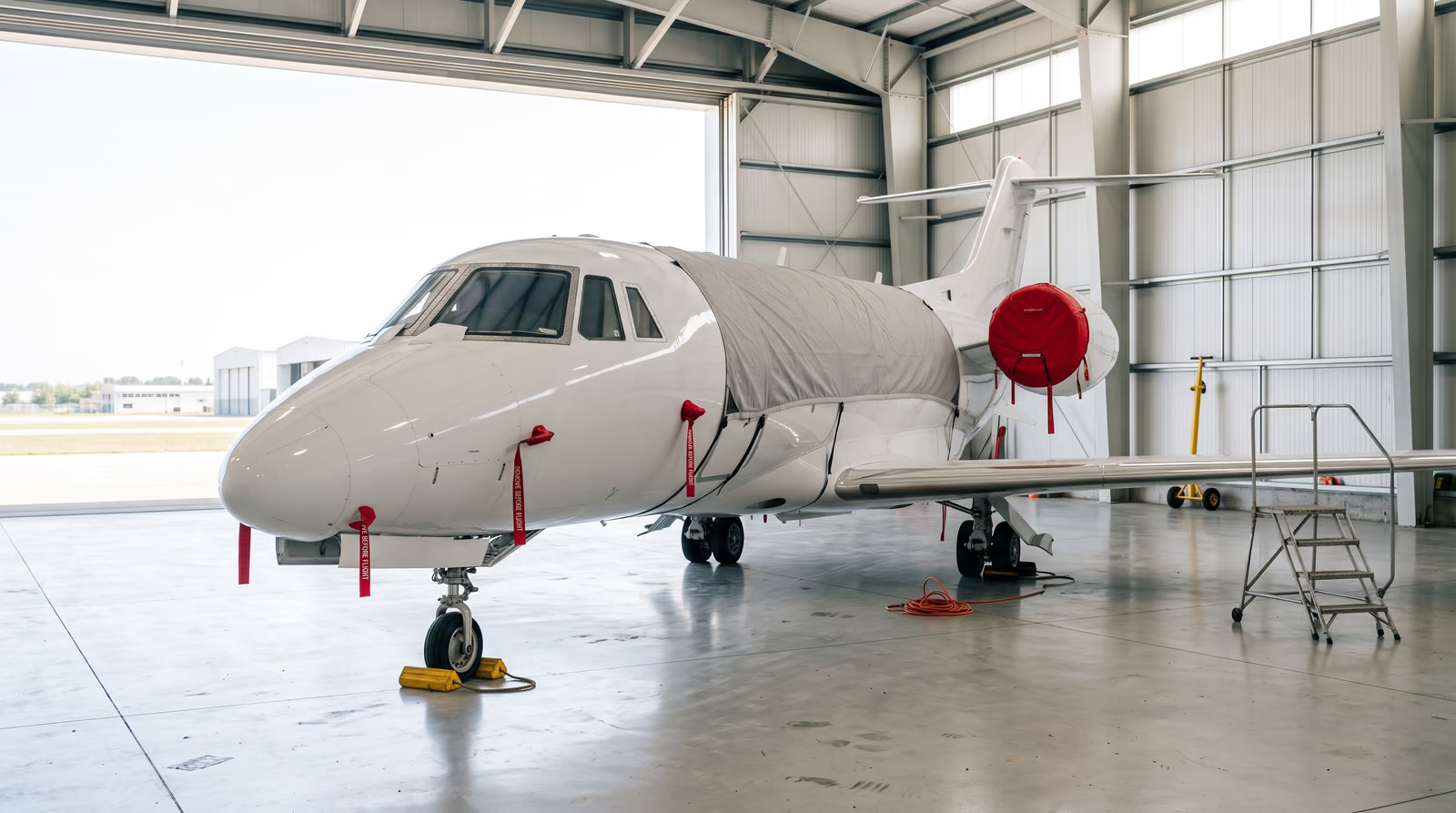
Fifteen percent of the world's billionaires own a private aircraft, roughly three times the share that owns a yacht. That single ratio, published by the wealth intelligence firm Altrata in its Billionaire Census 2026 on 27 August, is the clearest published measure of where business aviation actually sits in the hierarchy of things the very rich buy.
The census counts 3,795 billionaires worldwide holding a combined $15.1 trillion. The population grew 8.2 percent in a year, an addition of 287 people and the strongest expansion in five years, while total wealth rose 12.8 percent. The average fortune is about $4 billion and the median roughly $2 billion, which is a reminder that the typical billionaire is not the figure who appears in headlines.
Two caveats belong with any of these numbers. The census reports 2025 data published in August 2026, so it describes the year that closed. And Altrata models a population rather than reading a registry: these are researched estimates of private balance sheets, not filings.
The jet is the asset that separates
Against 15 percent aircraft ownership, Altrata puts yacht ownership at about 5 percent. More than 200 billionaires own a stake in a sports team. Aviation, meaning aircraft ownership or luxury charter, ranked third among billionaire interests across all three wealth tiers Altrata tracks, in separate research the firm published in March 2026.
That ordering is not decorative. A yacht is a destination, and a seasonal one. An aircraft is infrastructure, bought because the calendar demands it and justified as a working expense rather than a pleasure. When one asset appears at three times the penetration of another among the same buyers, the difference is function, not fashion.
The 15 percent figure also carries a boundary that matters more to this industry than the headline does. It measures ownership, and only among billionaires. It does not count the fractional shareholders, jet card members and charter clients who make up the overwhelming majority of private aviation demand, and who sit well below the billion dollar line. Roughly 570 people worldwide own an aircraft on this measure, against a global business jet fleet in the tens of thousands. The census describes the top of the pyramid, not the market.
That gap is where the operating businesses live, and it is the pattern visible in one broker's half year, where growth showed up in jet cards and longer missions rather than outright purchases.
The buyer pool, counted
Altrata's Billionaire Census 2026, published 27 August 2026, reporting 2025 data
Who owns what
Share of billionaires holding each asset. Ownership only: fractional shares, jet cards and charter are not counted.
Where they are
Billionaires by region. The seven regions sum to the global total of 3,795.
How concentrated
Share of all billionaire wealth held by the very largest fortunes.
Source: Altrata, Billionaire Census 2026. Figures are Altrata's modelled estimates of a population, not a public register. The 2017 comparison covers the ten largest fortunes; the 2025 figure covers the 29 individuals worth more than $50bn each.
Where the buyers are, and how old they are
North America holds 1,337 billionaires and $6.8 trillion, about 35 percent of the population and 45 percent of the wealth. Europe follows with 1,081 and Asia with 881. The Middle East accounts for 254 billionaires holding $0.7 trillion, roughly 7 percent of the global count. New York leads the city rankings with 164, ahead of Hong Kong at 106, San Francisco at 99 and London at 79. Germany was the fastest growing of the top 15 countries at 20.1 percent.
Those cities are unusually international. Altrata puts the foreign-born share of billionaires at 60 percent in London, 41 percent in San Francisco and 19 percent in New York. A mobile owner base is an aviation datapoint in itself: it implies multi-jurisdiction flying, longer legs and a bias toward aircraft that cross an ocean without stopping, which is what the order books have been showing.
The age profile is the number the industry should sit with longest. The average billionaire is 71. Around half are over 70 and only 9 percent are under 50. Thirteen percent are women and 62 percent are self-made.
A fleet changing hands
Altrata projects $6.6 trillion transferring over the next decade to roughly 5,000 direct heirs, of whom about 1,370 are spouses and 90 percent of those are women. The adult children in line average 48 years old, and only 23 percent work in the family business.
For aircraft owners this is a succession question with a maintenance schedule attached. An aircraft is one of the few estate assets that costs money every month it sits, carries a mandatory inspection calendar and loses value when its records go untended. A handover concentrated into a single decade points to more aircraft reaching the market through estates rather than the usual upgrade cycle, and to heirs who have to be taught what they hold. The condition of the logbook decides the number, which is why the pre-purchase inspection determines the transaction rather than merely confirming it.
The concentration underneath
The census records an intensifying concentration at the top. Twenty-nine superbillionaires worth more than $50 billion each now control 27.2 percent of all billionaire wealth. In 2017, the top 10 held 7.2 percent. Companies making meaningful AI investments saw valuations climb 23 percent faster over 2024 and 2025 than those that did not, which is most of the explanation for a year in which wealth grew faster than the population holding it.
That concentration is the pattern AVNET has recorded across three asset classes this month. Fewer superyachts changed hands in the first half of 2026 for considerably more money. Collector cars set a $756 million record at Monterey while the mid-market stalled. Preowned jets held their value at seven years. The census supplies the demand-side explanation those prints were missing: the buyer pool grows modestly while the money inside it piles up at the top.
One last figure defines the scale of the opportunity and its ceiling at once. Real estate and luxury assets together account for under 2 percent of holdings for billionaires worth more than $5 billion, and 4 percent below that. Aircraft come out of a rounding error on a balance sheet that is 38 percent public equity and 35 percent private company stakes. Passion assets grew 13.3 percent a year per billionaire over the past decade, faster than the fortunes themselves, but they will never be where the money is. They are where it goes when there is enough of it.