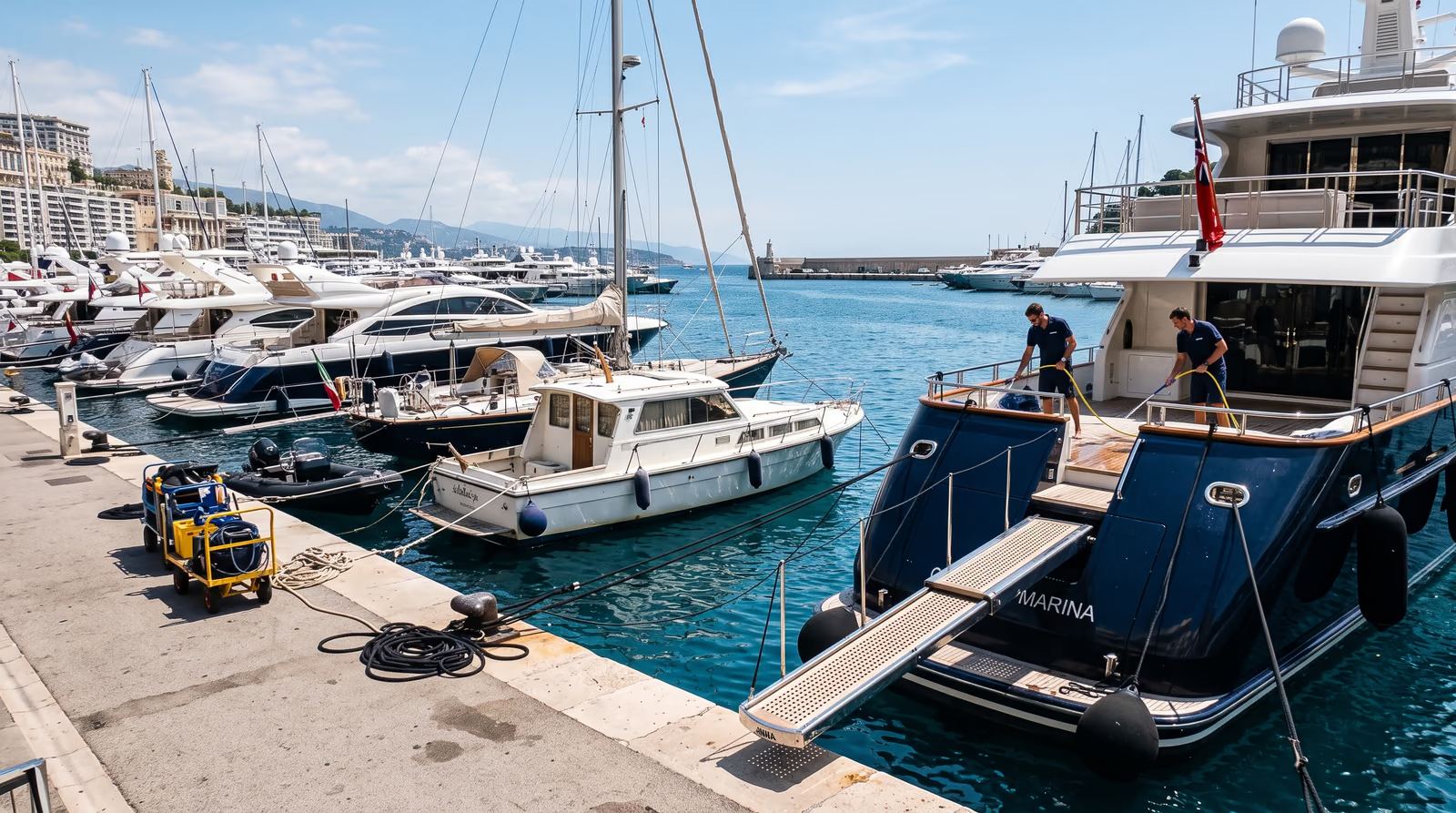
Buyers took 326 preowned superyachts off the market in the first half of 2026, eight percent fewer than the 354 sold in the same period last year. They paid $3.51 billion for them, fifteen percent more than the $3.05 billion spent a year earlier. The average boat changed hands for roughly $10.8 million, up about twenty five percent.
Those figures come from the Q2 2026 Superyacht Market Report published by brokerage house Northrop and Johnson on 16 July 2026, and they describe a market doing something that is easy to misread. Fewer transactions and more money is not a slowdown. It is a change in what gets bought.
A Second House Says the Same Thing
Northrop and Johnson is a brokerage reporting on the market it earns fees in, so the headline direction is worth checking against someone else's book. IYC, reporting separately on the same six months, counted 444 yachts sold for a total of $4.56 billion, an average of about $10.27 million per boat. The unit counts differ because the two houses count different fleets, and neither number should be read as the industry total. What matters is that both describe the same shape: transaction volumes moderating against the first half of 2025, total value rising anyway on the strength of larger deals.
Data compiled on yachts above 24 metres points the same way over a slightly different window. Between January and May 2026, 258 such yachts sold worldwide, down 13.7 percent by volume year on year, while total value edged up 1.7 percent to roughly $2.72 billion.
Three counts, three different definitions of the market, one direction.
Where The Money Actually Went
The split by type is stark. Motoryacht sale value reached $3.44 billion, up eighteen percent. Sailing yacht sale value came in at $79.5 million, down forty seven percent. Sail is now a rounding error in a market it once defined.
Size tells the rest. The 131 foot to 164 foot bracket, roughly 40 to 50 metres, posted 45 sales in the year to date, ahead of the equivalent figure in 2025, 2024 and 2023. Demand held up best where the boats are biggest.
The single largest result of the half was Moonrise, a 327 foot 9 inch Feadship delivered in 2020, which came to market in January and found a buyer inside 159 days. Its last asking price was €325 million, about $377 million at the report's conversion. The agreed transaction price was never disclosed, and no published figure should be treated as one. Burgess represented the seller and Edmiston the buyer.
Inventory at 1 July stood at 2,157 preowned yachts carrying a combined asking value of $18.8 billion, split 1,891 motoryachts to 266 sailing yachts. On the new build side, 142 orders were placed against 177 in the first half of 2025, with 936 yachts under construction and 466 scheduled for delivery this year against 411 actually delivered across all of 2025.
Fewer Boats, More Money
Preowned superyacht transactions in the first half of 2026, against the first half of 2025.
The Aviation Comparison, And Where It Breaks
An aviation title has an obvious reason to read a yacht report: the same people buy both, and business aviation has spent 2026 printing numbers that look like a cousin of these. The comparison is real, but it is not the tidy mirror it first appears to be, and the difference is the interesting part.
Start with what genuinely matches. Scarcity at the top is the defining feature of both markets. AVNET's reporting on the preowned business jet market found inventory at 5.8 percent of the active fleet at the end of June, well under the ten year average of 7.2 percent, with business jets tighter still at 6.5 percent available against a historical 8.1 percent. Buyers in both markets are competing for a thin supply of good, young, large assets, and paying up to win them.
The value composition matches too, and revealingly so. AMSTAT data shows business jet median values up five percent year on year while average asking prices across listings fell twenty nine percent, a divergence AMSTAT general manager Andrew Young attributes to younger, higher value jets trading while older, lower value units sit unsold and drag the average down. Heavy jets show the same split, with median values up thirteen percent against a thirty four percent fall in average asking prices. That is precisely the yacht market's story of falling units and rising value, seen from the other side.
Where the analogy breaks is volume, and it breaks hard. Yacht transactions fell eight percent. Business jet transactions rose. AMSTAT recorded preowned business aircraft transactions up 11.2 percent year over year in the second quarter, and IADA's accredited dealers closed 746 deals across the first half against 616 a year earlier, an increase of twenty one percent. Aviation is concentrating value while doing more deals. Yachting is concentrating value while doing fewer.
The order books diverge as well. Yacht new build orders fell to 142 from 177, while AVNET's reporting on the record business aircraft order backlog put order books at $66.8 billion at the end of Q2, up 20.4 percent year on year with a book to bill above one to one.
What To Take From It
The honest read is narrower than the one a single headline supports. Both markets show large private capital moving toward the scarce, the large and the newly built, and away from the ordinary example of an ageing asset. Neither market is evidence for the other on volume, and a yacht print is not a forecast for an airframe.
For a buyer weighing hard assets this year, the transferable lesson is about the spread rather than the average. In both markets the gap between what a sought after asset fetches and what a common one fetches has widened enough that the market average has stopped describing either end of it. The next fixed point for the yacht half of that picture is the Monaco Yacht Show in late September.