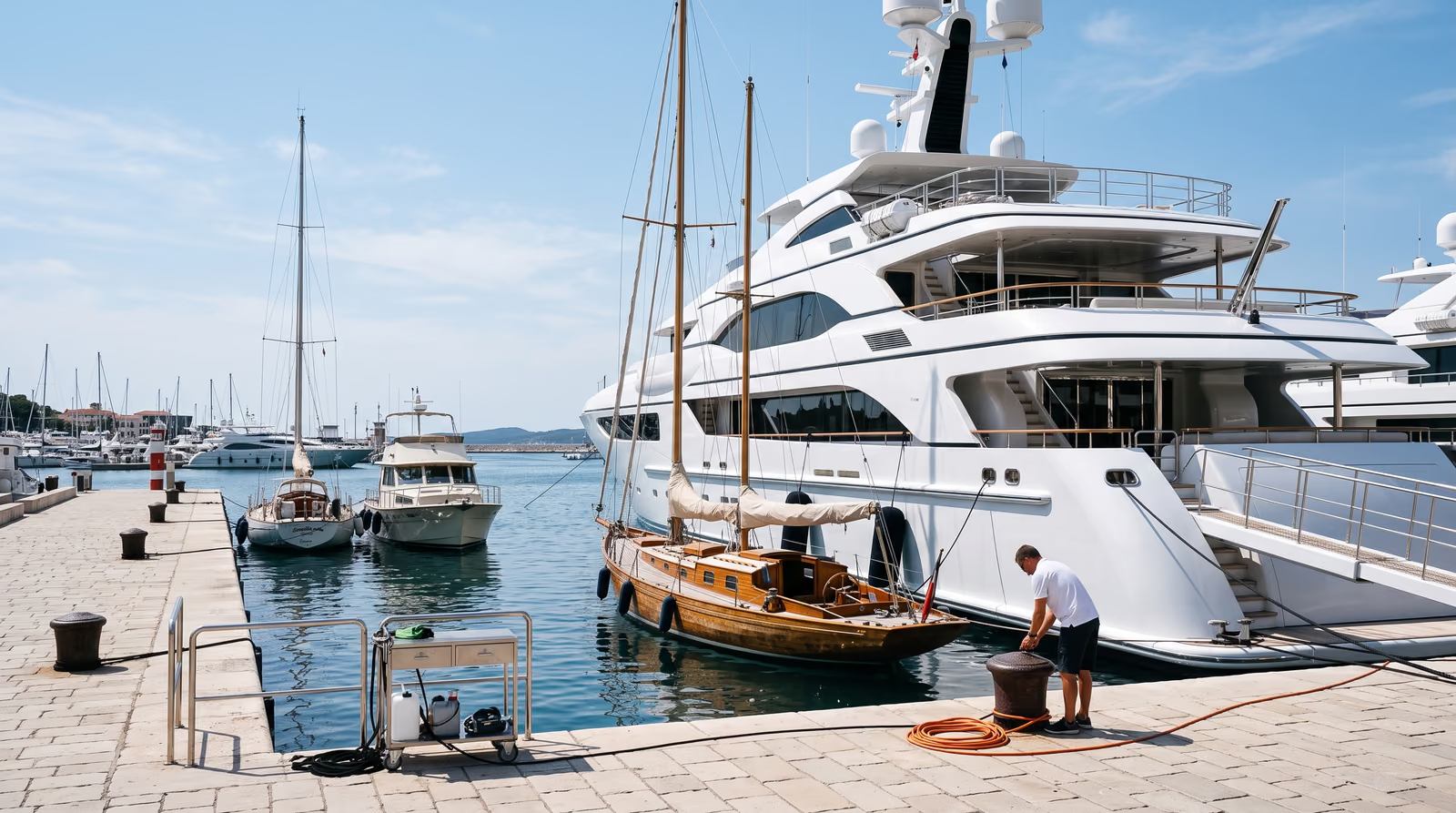
A 50 metre motor yacht costs between USD 2.3 million and USD 4.1 million a year to run, before a dollar of depreciation, and of the four charter yachts whose owners have published their accounts, three lose money. Those two numbers frame the question, and neither is the purchase price.
Anyone who has run this arithmetic on an aircraft knows the grammar: fixed cost, variable cost, depreciation kept in its own line, and a break-even utilisation that decides whether owning beats chartering. Our breakdown of what it costs to own a private jet for a year sets it out. The boat answers to the same structure and gives very different answers, because two line items dominate it that have no equivalent in a hangar.
The ten percent rule, and what the brokers actually say
Brokers commonly plan on annual running costs of 10 to 15 percent of a yacht's purchase value. Fraser Yachts publishes that range and works the example: a EUR 20 million vessel costs EUR 2 million to EUR 3 million a year. Ocean Independence puts the band wider at 10 to 20 percent. The spread is the first useful signal: at a EUR 20 million purchase, the difference between 10 and 20 percent is EUR 2 million a year.
This is a heuristic, not a measurement. No source publishing it measures a fleet. It should be checked against the line items rather than trusted on its own. And since every percentage here is a percentage of a purchase price, the denominator matters: our report on the superyacht market in the first half of 2026 covers what boats are actually transacting at.
The cost stack, line by line
Ocean Independence publishes a full annual breakdown in US dollars at three sizes. At 30 metres: crew USD 300,000 to 500,000, fuel USD 80,000 to 150,000, maintenance and refit USD 200,000 to 350,000, insurance USD 20,000 to 50,000, berthing USD 40,000 to 100,000, tenders and toys USD 30,000 to 80,000, for a total of USD 670,000 to 1.2 million. At 50 metres the total runs USD 2.3 million to 4.1 million. At 80 metres, USD 5 million to 9 million.
Crew is the largest line at every size, and the most often underestimated. The Antibes agency YPI CREW publishes a 2026 salary guide drawn from live placements. In the 50 to 60 metre band, monthly euro ranges run: captain EUR 10,000 to 16,000, chief officer EUR 7,000 to 8,000, chief engineer EUR 8,000 to 12,000, head chef EUR 6,500 to 9,000, chief stewardess EUR 5,500 to 7,500, second stewardess EUR 3,300 to 4,500, bosun EUR 4,500 and upward. YPI CREW is explicit that these are indicative starting ranges only, and that rotational packages typically sit 10 to 20 percent below their non-rotational equivalents.
Take the midpoint of each and build a core of eight on a 50 metre, with two second stewardesses. The computed arithmetic comes to roughly EUR 57,050 a month, or about EUR 684,600 a year in gross salary. That is a floor, not a budget: Fraser Yachts puts a mid-size vessel at eight to fifteen full-time crew, and BOAT International has a 60 metre carrying fourteen. Set that euro figure against Ocean Independence's USD 1 million to 2 million for all-in crew at the same size, and at any exchange rate of the last year the conclusion holds. Salaries are roughly half of what crew actually cost, once flights, rotation cover, insurance, training, uniforms, crew food and recruitment fees are added.
Berthing is the line where published information almost disappears. Monaco is the exception. The Société d'Exploitation des Ports de Monaco publishes its full 2026 Port Hercule passage tariff in euros with 20 percent VAT included, high season running 1 May to 1 October. The 50.00 to 54.99 metre band is EUR 13,749.60 a month in low season and EUR 25,207.20 in high. Five high months and seven low months is a computed EUR 222,283.20 for the year. The 40.00 to 41.99 metre band works out at EUR 104,170.80 on the same basis, and the 60.00 to 64.99 metre band at EUR 257,095.20.
These are transient rates, not the cost of a Monaco berth in general: private berth concessions on the quay are a separate market. What the tariff does show is how sharply pricing steps with length. High season moves from EUR 12,255.60 a month in the 42.00 to 43.99 metre band to EUR 16,741.20 in the 44.00 to 45.99 metre band, about 37 percent more for two metres of boat.
Elsewhere, nobody publishes. Dubai Harbour lists 705 berths, vessels to 160 metres, bunkering, pump-out, slipway and 24 hour berthing assistance, and no rates at all, only a berth enquiry form. Mina Rashid advertises linear quay walls that take yachts of any size, and quotes on request. OneOcean Port Vell in Barcelona and Port Vauban in Antibes work the same way. Figures do circulate in secondary content, none traces to a source, and they should not be used.
Depreciation, the line most budgets leave out
Ocean Independence puts depreciation at roughly 10 percent in year one, then 6 to 8 percent a year, for a cumulative 40 to 50 percent over five years. On a USD 25 million 45 metre boat, that is a computed USD 2 million to 2.5 million a year of value, which is comparable to the entire cash running cost.
It belongs in its own line and must not be folded into the 10 to 15 percent rule, which already excludes it. Adding the two together double counts. The jet guide makes the same separation for the same reason.
What chartering the same yacht costs
Burgess puts the minimum weekly rate for one of its charter yachts at around EUR 70,000, varying with size, facilities and season. On top of the base fee sits the Advance Provisioning Allowance, typically 20 to 40 percent of the charter fee. APA covers food and drink for the charter party, trips ashore, fuel for the yacht and its tenders, and port fees.
What APA does not cover matters as much: VAT varies by cruising ground, delivery and redelivery are extra where the charter does not begin at the yacht's location, and agent commissions arise on port bookings and customs clearances. Gratuity is customary at 10 to 15 percent of the charter fee. The same own versus charter decision one asset class over is worked through in our guide to what it costs to charter a private jet.
Chartering it out, and why the offset disappoints
Four charter yachts, four sets of real accounts
Annual running cost against net charter income, in euros, as published by BOAT International in April 2025. Three of the four lose money.
Result: plus EUR 17,000
Result: minus EUR 444,000
Result: minus EUR 430,000
Result: plus EUR 2,159,832
Break-even, computed by AVNET: divide each yacht's running cost by the midpoint of its own weekly rate and the three motor yachts all land at roughly 5.6 to 5.7 weeks. The sailing yacht needs about 11.4 weeks, because its weekly rate is low against its running cost. Bars are scaled to the largest figure shown.
BOAT International published four real owner profit and loss statements in April 2025. They are the most useful document in this category because they are accounts rather than estimates.
A 48 metre Italian motor yacht from 2017 ran seven Mediterranean summer weeks at EUR 250,000 to 310,000 and finished EUR 17,000 ahead, on EUR 1,592,000 of net charter income against EUR 1,575,000 of running cost. A 47 metre Dutch sailing yacht from 1998 chartered nine weeks across the Mediterranean and Caribbean at EUR 110,000 to 125,000 and lost EUR 444,000. An 85 metre German motor yacht from 2010 did eight weeks at EUR 850,000 to 950,000 and lost EUR 430,000. Only a modelled 60 metre northern European boat cleared its target, on twelve weeks.
The pattern underneath is more stable than the outcomes. Divide each yacht's running cost by the midpoint of its own weekly rate and the computed break-even lands at about 5.6 weeks for the 48 metre, about 5.7 for the 85 metre, and about 5.6 for the 60 metre model. Three boats of very different size and age need almost exactly the same number of their own charter weeks to cover a year. The sailing yacht is the outlier at about 11.4 weeks, because its weekly rate is low against its running cost, which is why it lost most relative to its size.
BOAT International's survey holds that eight to ten weeks is a successful programme, twelve in the 60 metre market, and that the ideal size for charter profitability is 50 to 60 metres. Break-even at 5.6 weeks against a successful season of eight to ten sounds like comfortable headroom. Three of the four sets of accounts say otherwise, because the weeks booked, the rates achieved and the commissions paid rarely all land at once.
The arithmetic looks different from the charterer's side. Add APA at 35 percent to a EUR 280,000 week and the all in figure is EUR 378,000, so a computed 4.2 weeks of chartering covers that 48 metre's annual running cost. Add the customary gratuity and it is under four, before any capital, depreciation or opportunity cost enters the comparison.
Dubai in winter, the Mediterranean in summer
The Gulf fleet is real and growing. SuperYacht Times data puts 311 privately owned superyachts over 30 metres across the Arabian Gulf states, 5.3 percent of the global fleet, with UAE residents owning 48 percent of them, up 4 percent since 2023. Charter bookings in the UAE rose around 379 percent between 2019 and 2023. Dubai hosts 22 marinas with over 3,750 wet berths and 640 dry berths.
The constraint is size, not volume. Mike Ward, managing director of Marina Projects, told the SuperYacht Times Gulf Summit that 80 percent of berths in the Gulf accommodate vessels only up to 40 metres, with 60 further marinas planned. For a 50 metre and above, the shortlist is short, and Dubai Harbour at 160 metres maximum and Mina Rashid's linear quay carry most of it.
Clearance has moved faster than berth stock. Hilary Ackermann of JLS Yachts told the same summit that golden agent status from the UAE's Ministry of Energy and Infrastructure lets the firm issue clearances in as little as one hour.
The season is the real argument. A Gulf winter base puts the yacht to work from October to April, when the Mediterranean is shut and a single season boat sits on a wintering contract earning nothing. A two season pattern changes the denominator rather than the cost, which is the only lever in this calculation that moves in the owner's favour.