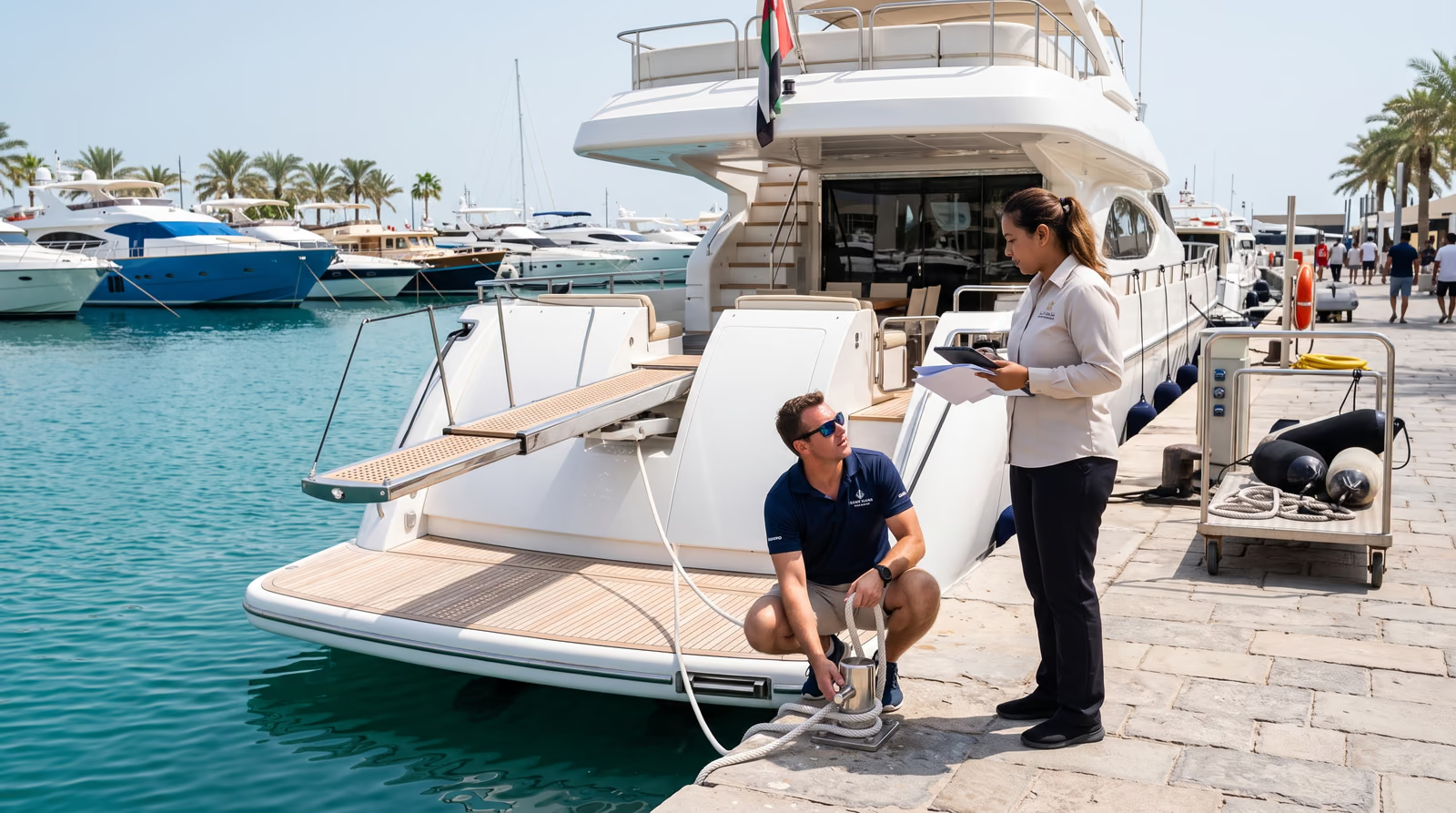
Owning a yacht of 40 metres or more is now enough to qualify for a 10 year UAE Golden Visa, in either Abu Dhabi or Dubai. Abu Dhabi opened the route at the end of 2024 under a programme called Golden Quay, and Dubai followed in February 2025, in the week of the Dubai International Boat Show. Both schemes also cover the people who build, sell, insure and service those yachts, and the immediate families of everyone who qualifies.
On price alone, it is not the easy way in. A Dubai property worth AED 2,000,000, roughly US$545,000, already qualifies its owner for the same 10 year visa, according to the Dubai Land Department. Knight Frank's Wealth Report 2026, citing BOAT International, puts the average asking price of a superyacht sold in 2025 at US$16.6 million, about 30 times the property threshold. Nobody buys a 40 metre yacht to get a visa. The scheme exists for owners who already have one, and for the question of where that yacht spends the winter.
What the two schemes actually offer
The headline benefit is the standard Golden Visa package. The holder can live, work and study in the UAE without a local sponsor or employer, and, unlike an ordinary two year residence permit, can spend long periods outside the country without the visa lapsing. Family members can apply for dependent Golden Visas that run for the same period as the principal holder's, according to the immigration law firm Fragomen.
The eligibility lists are close to identical in the two emirates.
| Abu Dhabi (Golden Quay) | Dubai (Superyacht Golden Visa) | |
|---|---|---|
| Launched | December 2024 | February 2025 |
| Run by | Department of Culture and Tourism Abu Dhabi, Abu Dhabi Investment Office, Yas Marina | GDRFA, Dubai's residency authority |
| Yacht owners | Vessels of 40 metres or more | Vessels of 40 metres or more |
| Industry | CEOs and major shareholders of yacht builders, central agents, service and insurance providers | Same categories |
| Family | Immediate family eligible | Immediate family eligible |
| Visa term | 10 years, renewable | 10 years, renewable |
| Extras | Preferential berthing rates, marina investment incentives | Six month multiple entry crew visa, mobile marina services |
The extras are where the two schemes show what they are for. Abu Dhabi's version, as summarised by Sovereign Group, pairs the visa with preferential berthing rates and incentives to invest in marinas. Dubai's announcement came with a six month multiple entry visa for crew and a mobile marina service promising processing times under 30 seconds. Both are marine tourism measures that happen to include a residence permit, not immigration measures that happen to mention boats.
Who the route is actually for
The obvious reader is an owner who already cruises the Gulf in the northern winter. For that owner, the visa turns a seasonal berth into a legal base, with the family covered on the same terms. It also makes the UAE's personal tax position relevant to someone who previously treated Dubai as a stopover, although residency and tax residence are separate tests and the second needs its own advice.
The less obvious reader is the industry itself. The executive categories reach well beyond owners: a yacht builder's chief executive, a major shareholder, a central agent, an insurer or a service company can qualify without owning a hull. That matters to the brokerage and refit businesses that follow the yachts, and it is probably the half of the scheme that will be used most often, because there are far more people working in yachting than there are owners of 40 metre yachts.
There are not many of those owners. Figures cited by Gulf News in February 2025 counted 195 new yacht sales and 305 used yacht sales over 30 metres worldwide in 2024, three to five percent below 2023. A 40 metre threshold cuts that pool further. The scheme is aimed at a few hundred transactions a year, at most, across the whole world fleet.
The market behind the policy
The timing follows the money. Knight Frank reports that the total value of superyacht sales rose 70 percent in 2025, with the ultra-large bracket of 70 metres and above up about 60 percent. The size of the wealth pool behind those sales is still rising: Knight Frank counts 713,626 people worth more than US$30 million in 2026, up from 551,435 five years earlier.
Dubai's own housing market is already the landing point for part of that wealth. Knight Frank's Prime International Residential Index recorded a 25.1 percent rise in Dubai's luxury prices during 2025, against an average of 3.2 percent across the 100 cities it tracks, and we covered the record trophy sales behind that figure in our report on Dubai's ultra-luxury property market. The superyacht visa gives the same buyer a second way to anchor residency, through the asset that is most mobile of all.
The volume of Golden Visas in general shows the appetite is not a niche one. Dubai's residency authority granted 66,000 Golden Visas in the first half of 2026, alongside more than one million new residence permits, according to figures reported in August 2026. No separate count has been published for the superyacht category.
Where the yacht goes
A visa that rewards a 40 metre yacht only works if the yacht has somewhere to go. Dubai Harbour, which opened in 2020, offers around 1,100 berths for yachts of up to 160 metres, according to Superyachts.com. Mina Rashid Marina, the traditional port of entry for visiting superyachts, lists capacity for 424 yachts between 15 and 80 metres plus seven alongside berths for vessels over 80 metres, according to the cruising guide Noonsite. Abu Dhabi's scheme runs through Yas Marina, which also acts as the channel for applications there.
That is the practical difference between the two routes. In Abu Dhabi the marina is written into the process: summaries of the scheme describe Yas Marina recommending candidates and the Abu Dhabi Investment Office handling the application. In Dubai the published material names the residency authority and the eligible categories, but says less about the nominating body.
For owners weighing where the yacht spends its winters, our analysis of the superyacht market's first half of 2026 sets out how the brokerage market is trading and where the value is concentrated.
What the published rules do not say
The public descriptions of both schemes are short, and several questions an owner will ask are not answered in them.
- Does the yacht have to be in the UAE? Neither summary we reviewed says the vessel must be registered under the UAE flag or berthed in a UAE marina for any minimum period. Abu Dhabi's link to Yas Marina suggests that in practice the marina relationship is part of the case.
- How is ownership proved? Most large yachts are held through a company, often in another jurisdiction. The schemes speak of yacht owners, and an owner holding the vessel through a structure should expect to show beneficial ownership, not just a registration certificate in a company's name.
- What happens if the yacht is sold? The published summaries do not say whether the visa survives the sale of the qualifying yacht. It is the first thing to confirm before relying on the visa for school places or a banking relationship.
- Is the length overall or load line? Yachts are measured several ways, and a vessel near 40 metres can fall either side of the line depending on which figure is used.
None of these gaps means the route does not work. It means an application should be prepared with the nominating marina or the residency authority directly, rather than from a summary.
What an application involves
The mechanics follow the wider Golden Visa system. Guides published by UAE residency service providers describe an eligibility check through the federal immigration portal or an authorised agent, followed by a document file: proof of yacht ownership, passports and photographs, health insurance and bank statements. Executives applying under the industry categories replace the ownership evidence with proof of their role or shareholding in the yachting business.
Applications are then filed with the federal identity and citizenship authority or with the emirate's own residency department. In Abu Dhabi, the marina recommendation comes first. Once the principal visa is issued, dependants are added on the same term.
The practical advice is to start with the marina. An owner who already holds a berth contract in Dubai or Abu Dhabi has the relationship that the schemes are built around, and the file that proves it.
The short version
For an owner of a yacht of 40 metres or more, the UAE now offers 10 years of residency for the family on the strength of the boat, in either of its two largest emirates. For anyone who only wants the visa, a property worth AED 2,000,000 remains a far cheaper door. The yacht route makes sense for the owner who was going to keep the yacht in the Gulf anyway, and for the executives and service companies that follow those yachts into port.