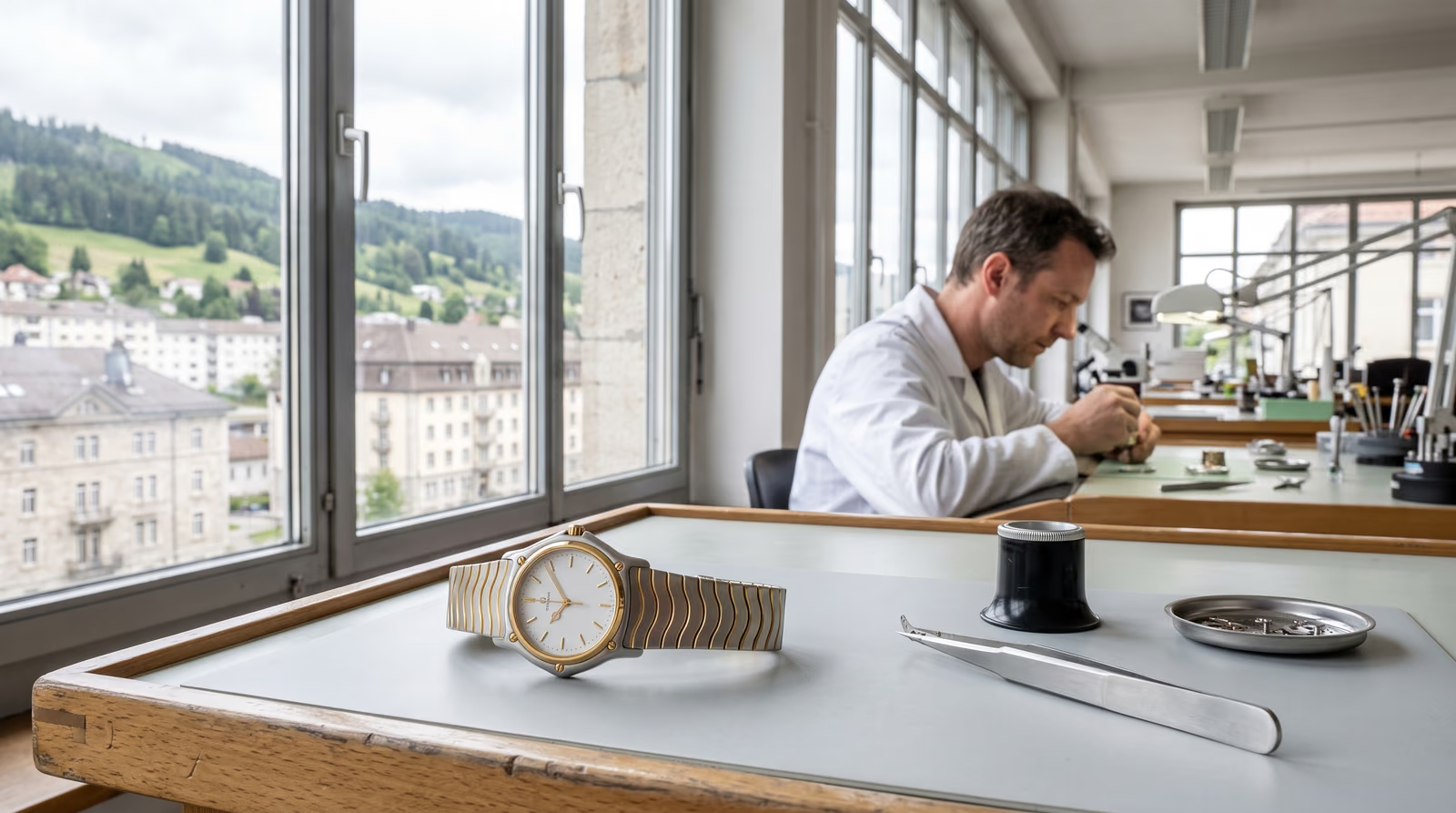
Movado Group has agreed to sell 95 percent of Ebel for 66.5 million dollars to a buyer group led by Montres Journe, the Geneva company behind F.P. Journe, with Chanel taking part and the former De Bethune chief executive Pierre Jacques set to run the brand. Movado announced the binding agreement on 8 October and keeps the remaining 5 percent.
Twenty-two years ago Movado paid less for the whole business. Its filings from 2004 record a cash price of 47.9 million Swiss francs for the main Ebel business, about 37.8 million dollars at the exchange rate on the day the purchase from LVMH closed in March of that year. The deal now on the table values Ebel at roughly 70 million dollars on a whole-company basis. That is arithmetic on the announced price, not a disclosure, and the release warns the final price may move after adjustments.
The price matters less than the buyers. An independent watchmaker whose own pieces are made in small numbers, backed by a fashion house with a growing portfolio of Swiss watch businesses, has chosen to spend its money on a fallen name from the middle of the market.
What Is Actually Changing Hands
According to Movado's release, the trademarks, other intellectual property, inventory and certain other assets dedicated to Ebel will first be moved into a newly formed Swiss subsidiary of Movado, and some Movado staff who work on the brand will become its employees. At closing, expected in the next few months, 95 percent of that subsidiary passes to the buyer group.
The package includes the Villa Turque in La Chaux-de-Fonds, a house designed by Le Corbusier that Ebel bought in 1986. Movado will support the new owners under a transition services agreement. The split of the 95 percent among the buyers has not been disclosed.
Why Movado Is Selling
Movado describes the sale as a sharper focus on its core business of accessible luxury and fashion watches and jewelry. Its own numbers explain the logic. In the fiscal year to 31 January 2026, Movado reported net sales of 671.3 million dollars. Licensed brands such as Calvin Klein, Coach, Tommy Hilfiger, Hugo Boss and Lacoste brought in 391.4 million of that, while the owned brands category, which groups Movado, Concord, Ebel, Olivia Burton and MVMT, fell to 172.5 million from 183.6 million a year earlier. Ebel's own revenue is not reported separately.
Ebel also sat at a different price point from the rest of the group. National Jeweler reports that most Ebel watches retail above 2,000 dollars and top out above 9,000, while the Movado brand offers many models below 2,000. Chairman and chief executive Efraim Grinberg called the sale a matter of strategic discipline in managing the portfolio.
Who Is Buying
Montres Journe was founded in Geneva in 1999 by François-Paul Journe and makes its watches and components in house. Chanel bought a 20 percent stake in the company in 2018. When that investment was announced, Journe said production would stay at about 900 watches a year.
Ebel extends a pattern. Chanel owns the case and bracelet maker G&F Châtelain outright, holds a majority of Bell & Ross and minority stakes in Romain Gauthier and, according to Monochrome, in MB&F and the movement maker Kenissi. Pierre Jacques led De Bethune for 15 years before stepping down last summer, according to National Jeweler.
"Like Michelangelo and so many others after him: the product, the product, the product," François-Paul Journe said in the release.
Ebel Changes Hands Again
Movado is selling 95 percent of the Swiss brand to a group led by Montres Journe, with Chanel and Pierre Jacques.
$66.5m
Price for 95 percent, before adjustments
c.$70m
Implied value of the whole brand (arithmetic, not disclosed)
CHF 47.9m
What Movado paid LVMH in 2004, about $37.8m at the time
5%
Stake Movado keeps after closing
115 years, five owners
- 1911Founded in La Chaux-de-Fonds by Eugène Blum and Alice Lévy
- 1970s to 1980sPeak under Pierre-Alain Blum; makes watches for Cartier under licence
- 1986Buys Le Corbusier's Villa Turque
- 1994Sold to Investcorp
- 1999Sold to LVMH
- 2004Sold to Movado Group
- 202695 percent agreed to Montres Journe, Chanel and Pierre Jacques; closing expected within months
Where executives see the market
Share of 42 Swiss watch supplier executives, Deloitte 2026 study
Sources: Movado Group release, 8 October 2026; Movado Form 10-K and 8-K, 2004; Monochrome; Time and Tide; Deloitte Swiss watch industry study 2026 via WatchPro.
A Name Worth More Than Its Recent Record
Ebel was founded in La Chaux-de-Fonds in 1911 by Eugène Blum and Alice Lévy, whose initials gave it its name. Under Pierre-Alain Blum in the 1970s and 1980s it became one of the largest Swiss brands, with revenue in the nine-figure range at its peak, according to Time and Tide. It made watches for Cartier under licence, was once the largest buyer of Zenith's El Primero chronograph movement, and gave the market the Sport Classic, with its screwed bezel and wave-link bracelet.
The decline began after Blum sold to Investcorp in 1994. LVMH bought the brand in 1999 and sold it to Movado five years later. For the next two decades it was one line in a fashion watch group's catalogue.
Where the Money Is Going
The deal fits a split that Deloitte's 2026 Swiss watch industry study found among supplier executives. As reported by WatchPro, 90 percent were positive on the most expensive category of watches, while 71 percent were negative on entry-level pieces and 52 percent on the mid-range. The sample was small, 42 executives, and they make parts rather than sell finished watches, but the split is stark.
Ebel, at 2,000 to 9,000 dollars, sits squarely in the band that executives are most worried about. The buyers are betting that the right owners can lift a name with real history out of that band, or at least give it a clear identity within it.
Swiss exports have been volatile this year, as AVNET's analysis of the August export figures shows, and the new owners have not set out a product plan, prices or a launch date.
What It Means for Collectors
For owners of existing Ebel watches, the release says the transition services agreement is meant to give continuity to customers while the brand changes hands. For buyers, the immediate effect is attention. Time and Tide's writer suggests vintage Ebel prices may rise on the back of the news, but that is opinion, not data, and no price record has yet shown it.
Anyone tempted to buy a 1980s Sport Classic at auction before the new owners show their hand should price the whole transaction, not the hammer. A buyer's premium and taxes can add more than a third to what is paid at the major houses.
The clearest signal is who is buying. A watchmaker that planned to make about 900 pieces a year when Chanel invested, and a fashion house that already owns or backs a string of Swiss craft businesses, have decided that a 115-year-old name is worth more to them than its recent sales suggest.