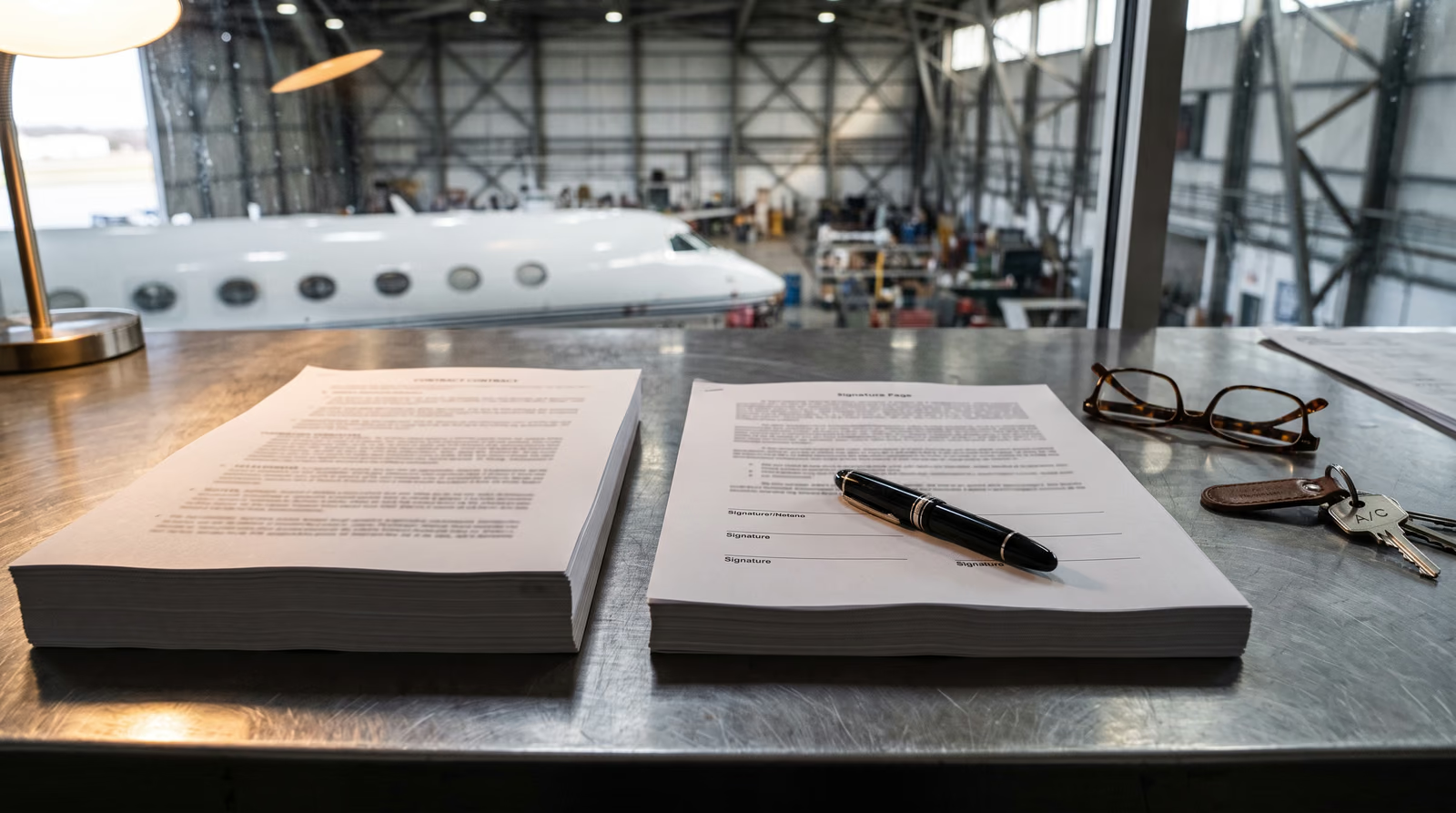
If Clay Lacy manages your aircraft, you are about to be asked to sign a new agreement. Solairus Aviation has agreed to buy Clay Lacy's aircraft management and charter divisions, and management contracts do not simply transfer with the business. Every owner has to choose, in writing, whether to move across.
The deal has not closed. Both companies are targeting the end of September 2026, subject to regulatory approval. That gap is the part worth paying attention to, because it is when the decisions get made and when every competing management company in the country knows exactly which owners are in play.
What Was Actually Agreed
Solairus is acquiring the aircraft management and charter divisions only. Clay Lacy's FBO, maintenance and real estate businesses are excluded and stay under the Clay Lacy name with their current ownership. Jefferies advised Clay Lacy. No purchase price was disclosed.
The combined business would be, in both companies' description, the world's largest managed business jet fleet, at more than 500 aircraft.
How Big, Depending on What You Count
The scale figures are worth stating carefully, because three different numbers are circulating and they measure different things.
Managed fleet. Solairus manages about 360 aircraft from more than 100 base locations across North America. For Clay Lacy the count depends on the source: Solairus's own release says about 140, while Doug Gollan at Private Jet Card Comparisons puts it nearer 160.
Charter certificates. Gollan counts 144 aircraft on the Solairus charter certificate and 51 on Clay Lacy's, a combined 195. Of those, 71 are Gulfstreams, 36 Bombardier Globals and 34 Dassault Falcons.
Aircraft actually chartering. In a follow-up interview, Solairus founder and chief executive Dan Drohan described roughly 100 aircraft actively engaged in charter after the deal, about 60 from Solairus plus 30 to 40 from Clay Lacy. That is a smaller number than the certificate count because sitting on a certificate and flying paying charter are not the same thing.
The ranking depends on the same choice of measure. By ARGUS 2025 charter hours, Solairus was 7th among US operators at 57,517 hours and Clay Lacy 17th at 12,237, which would place the combined entity 6th, behind flyExclusive and ahead of PlaneSense. Some summaries have called the combined company the second largest operator after NetJets. Both can be defended, because one counts managed fleet size and the other counts charter hours flown. Neither means much unless you say which.
The Part That Affects You: Your Contract Does Not Move Automatically
Drohan has been unusually direct about this. Every Clay Lacy owner has to sign a new agreement to come across to Solairus. Competitors are already calling those owners. Solairus has a six-month transition period to earn the business.
That is the practical reality of a management acquisition. You are not a transferred account. You are a customer whose contract is up, at a moment when your incumbent is distracted and every rival knows it.
What an Owner Should Check Before Signing Anything
The management fee, and what it now includes. Compare the new schedule line by line against your existing one. A fee that looks similar can cover a different scope. This is the line that sits inside the fixed block of your ownership costs, which AVNET breaks down in the real annual cost of owning a private jet.
Your crew. For most owners this is the real question. Ask directly whether your captain and first officer are being offered positions, on what terms, and whether they are contractually tied to your tail or to the manager's pool. Continuity of crew is the thing owners miss most when it goes.
Your charter revenue split. If your aircraft charters when you are not using it, the revenue share, the dispatch priority and the wear that comes with it are all negotiable, and they are being renegotiated whether you engage or not.
The maintenance relationship. Clay Lacy's maintenance business is not part of the sale. If your aircraft has been maintained inside the same group that manages it, that arrangement is now split across two companies. Ask who holds the relationship after closing.
Base and hangarage. Solairus operates from more than 100 bases. Confirm yours is one of them, and that the hangar arrangement survives the transaction.
Your exit. Whatever you sign, read the termination clause and the notice period. The reason you are being asked to sign at all is that the last agreement did not bind you to a successor.
Why This Keeps Happening
Drohan expects more of it, saying the deal "cracks the door open" and that others will follow.
The logic is straightforward. Aircraft management is a scale business with thin margins per tail: insurance, crew recruitment, training, parts purchasing and software all get cheaper per aircraft as the fleet grows. A manager with 500 aircraft buys better than a manager with 140. Consolidation is the obvious response, and the supply of independent mid-sized managers is finite.
For owners, the consequence is that this will not be the last time a management contract is put back on the table. The supply side is concentrating. What buyers are actually chartering, and how that demand is shifting toward larger aircraft and longer sectors, is the other half of the picture, and it is moving in its own direction.
The Short Version
An acquisition you did not choose has handed you a decision you did not plan for, on a timetable set by someone else. The one advantage is timing: for roughly six months you are a customer worth competing for, and that is the only period in which the terms are genuinely open. Owners who treat the new agreement as paperwork will sign the same deal they had. Owners who treat it as a renewal will not.
If the review prompts a broader rethink about whether managed ownership is still the right structure at all, fractional versus jet card versus charter sets out what the alternatives actually cost.