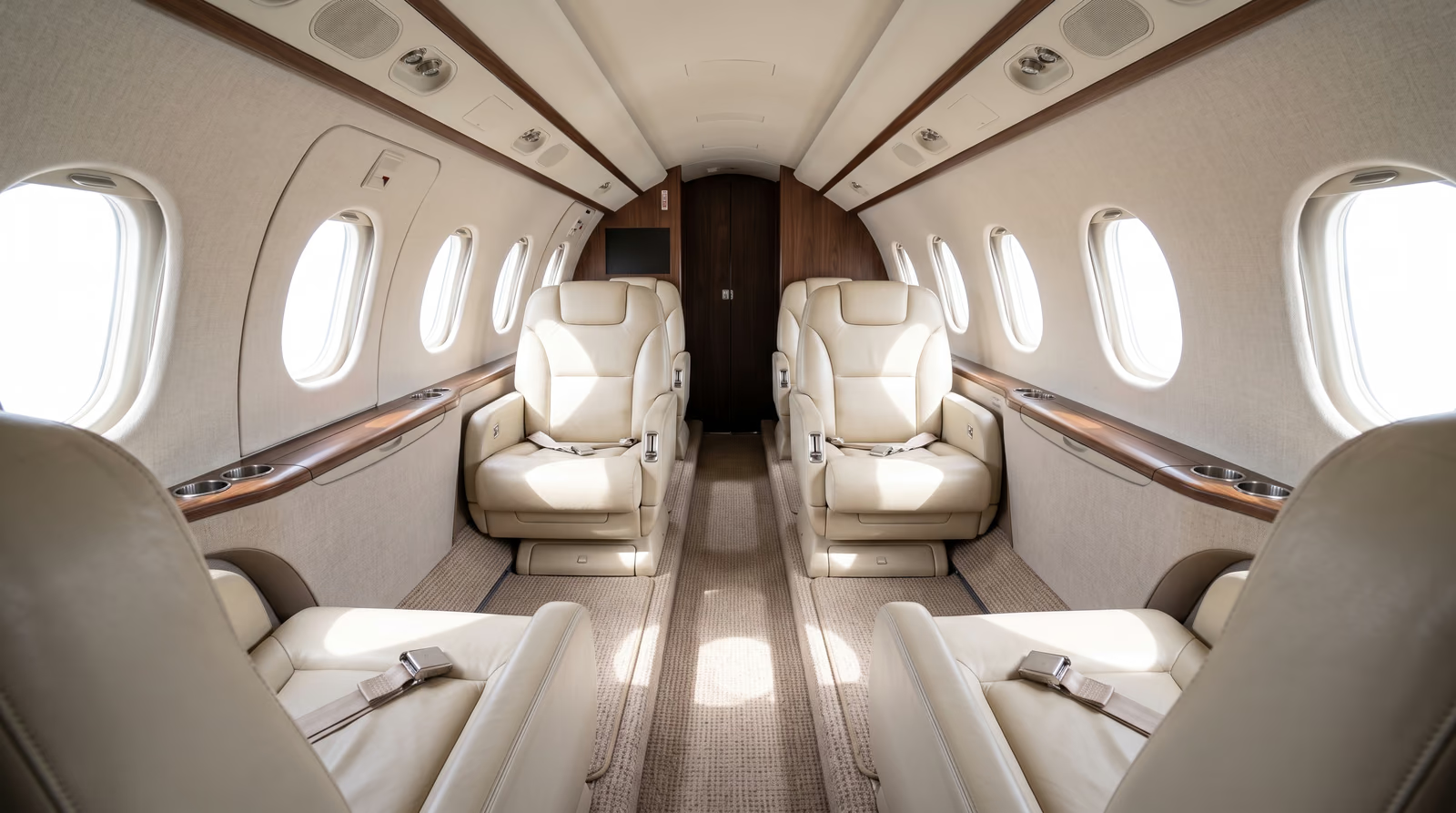
An empty leg is a private jet flight with no passengers aboard, sold at a discount because the aircraft has to make the trip regardless. Discounts commonly run 30 to 75 percent below the equivalent full charter, which is why the phrase is one of the most searched terms in private aviation and one of the most oversold.
The saving is real. So is the reason for it. An empty leg belongs to somebody else's itinerary, and it can be rerouted, retimed or cancelled outright if that itinerary changes. Everything worth knowing about empty legs follows from that single fact.
Why Empty Legs Exist at All
Empty legs are also called repositioning flights, ferry flights or dead legs. Private Jet Card Comparisons defines them as the flights an aircraft makes to reach a charter, jet card or fractional customer, or to return to base or to its next revenue trip after dropping that customer off.
They exist because charter aircraft do not live where passengers happen to be. A Geneva based jet that flies a client to Ibiza can either wait, tying up an asset and a crew, or fly somewhere useful. Either way the return sector operates without revenue unless somebody buys it.
The volume involved is substantial. XO, the air charter broker, estimates that 30 to 50 percent of the private jet charter fleet often flies empty. The European flight sharing platform Wingly has put the waste at roughly 10 million seats a year flying without passengers in Europe alone. Every one of those sectors burns fuel, consumes crew duty hours and adds an engine cycle to the maintenance clock, with nothing on the revenue side of the ledger.
That is why operators will sell an empty sector for a fraction of its list price. Any figure above the marginal cost of a flight they were going to operate anyway improves the economics of the trip that paid for it.
What the Discount Actually Buys
The headline range quoted across the market is wide but consistent. Private Jet Card Comparisons puts typical savings at 30 to 60 percent against a normal charter, sometimes more. Victor, Air Charter Service and Stratos Jet Charters all advertise savings of up to 75 percent. The Austrian operator GlobeAir goes further on its own short sectors, listing whole aircraft for four passengers from around 990 euros on a pricing curve that falls as departure approaches.
Set against the full charter benchmarks in AVNET's guide to what it costs to charter a private jet, the arithmetic on common corridors looks like this. The full charter column reflects broker published rates, the empty leg column the ranges listing platforms advertise on the same city pairs.
| Route | Full charter, one way | Typical empty leg |
|---|---|---|
| New York to Miami | $12,000 to $18,000 | $3,500 to $8,500 |
| Los Angeles to Las Vegas | $7,000 to $12,000 | $2,000 to $5,500 |
| London to Nice | $10,000 to $17,000 | $3,000 to $8,000 |
| London to Dubai (heavy jet) | around $130,000 | around $48,000 |
The transatlantic and Gulf sectors show why the percentage matters more than the price. A Gulfstream G650 positioning between London and Dubai is marketed at roughly $48,000 against a full charter near $130,000, a saving of more than $80,000 on a single sector. The same 60 percent discount on a Las Vegas hop saves about $5,000. Big aircraft on long sectors are where empty legs move real money.
Per seat, the numbers can drop below business class. The Points Guy has documented empty legs working out at about $1,115 a person on a New York to Florida sector with the cabin full, roughly $1,000 a person from San Diego to Chicago, and as little as 80 euros a person from Cannes to Toulouse. Those figures depend on filling every seat, a condition most groups cannot meet on 48 hours notice.
Empty Legs: The Price and the Price of the Price
A repositioning sector costs roughly 40 percent of the same trip booked as a full charter. What the discount removes is control.
What you pay against a full charter
Each bar is one route. The full bar is the standard one way charter price. The filled portion is what the same sector sells for as an empty leg.
Why the supply exists
What the discount costs you
Full charter benchmarks reflect published broker rates. Empty leg ranges reflect prices advertised on charter listing platforms. Fleet utilisation estimate: XO. Discount ranges: Private Jet Card Comparisons, Victor, Air Charter Service, Stratos Jet Charters. All figures are one way and in US dollars, current for 2026.
The Conditions Attached
An empty leg is not a discounted version of a charter. It is a different product with a different risk profile.
The route is fixed. Private Jet Card Comparisons notes that travellers generally cannot specify airports or departure times, because the routing exists to serve the operator's positioning need rather than the passenger's plan. If the aircraft is going from Farnborough to Nice, it is not stopping at Geneva.
The timing is fixed too, and it is set by the revenue flight. Listings typically surface two weeks to 48 hours before departure, and the deepest discounts appear closest to takeoff, which is precisely when a traveller has the least room to reorganise around them.
The flight is one way by definition. There is no return unless a second empty leg happens to align, which is rare enough that planning on it is a mistake.
Terms are tighter than on a full charter. Empty legs are commonly non-refundable, require immediate payment to hold, and allow little or no customisation of catering, ground handling or passenger manifest. Kari Bigot, a vice president at Chapman Freeborn, has warned that the terms and conditions attached to an empty leg carry a lot of stipulations and could ultimately cost the customer considerably more than the headline price suggests.
And the flight can disappear. If the originating client moves a meeting, the repositioning requirement moves with it. Listing platforms put the cancellation rate at roughly 10 to 15 percent. Operators usually give 24 to 72 hours of warning, though the nature of the product means they cannot promise even that.
Are They as Safe as a Full Charter?
Yes, with one technical caveat worth understanding.
When a passenger pays to fly an empty leg, it stops being an empty leg in the regulatory sense. It becomes a commercial charter, operated by the same certificated operator, on the same maintained aircraft, with the same qualified crew and the same duty and rest limits as any full price trip. In the United States that means Part 135 of the Federal Aviation Regulations, which imposes higher crew qualification thresholds, stricter maintenance and inspection standards and mandatory drug and alcohol testing.
The caveat concerns the genuinely empty version. Business Jet Traveler notes that when paying passengers are not aboard, including during empty leg repositioning between charters, the aircraft may and often does operate under the lighter Part 91 private rules. That is legal and routine. It matters only as a reminder that the operating certificate depends on whether money changed hands, which is why a cheap private flight offered by anyone other than a certificated operator or an established broker deserves suspicion.
Why So Many Listings Never Fly
The gap between advertised empty legs and flown empty legs is the industry's open secret. Shaan Bhanji, founder of the broker FlyEasy, has described empty legs as the standby of private aviation and the highest searched keyword in the category, calling them a marketing hook that reels in customers with a perceived opportunity rather than a reliable inventory of flights.
Operators are blunt about the fit. William Herp, chief executive of Linear Air, has said that empty legs seem like a good concept but that over twenty years of experience they rarely match up with a traveller's schedule. Chapman Freeborn's position is that empty legs are not reliable options for mission critical business travel, precisely because they are predicated on an originating customer's flight that could change or cancel. Victor's own guidance for corporate travellers says much the same.
None of that makes empty legs a scam. It makes them a clearance rack. The stock is real, the prices are real, and what is on the rack today is not what a particular buyer needs.
Where the Gulf Fits
Dubai generates empty legs in volume because traffic into the emirate is heavily one way in seasonal bursts. Aircraft arrive full for the winter season, exhibitions and Formula 1 weekends, then position back to Europe with nobody aboard. UAE brokers list Dubai to London, Paris, Geneva, Athens, Mykonos, the Maldives and Riyadh as the recurring corridors, with the outbound direction to Europe the more productive one for deals. The concentration of based fleets and handling capacity around Al Maktoum International, examined in AVNET's report on Dubai's move to DWC as its private aviation hub, keeps that positioning traffic dense and predictable.
Distribution in the region has moved to messaging rather than web listings. Several UAE operators now push daily availability through WhatsApp channels carrying route, aircraft type, seat count, date and price, which suits a product whose shelf life is measured in hours.
When an Empty Leg Is Worth It
The honest test has nothing to do with the discount. It is whether the trip in question can absorb a cancellation.
Empty legs work for leisure travel with soft edges, for a second home run where arriving Thursday or Friday makes little difference, for repositioning yourself rather than an aircraft, and for anyone curious enough about private aviation to want a trial that carries no membership, no minimum spend and no commitment beyond the sector booked. They also work for groups that can fill a cabin, since the price is for the aircraft and the per seat maths only works at full occupancy.
They do not work for a board meeting, a closing, a connection, a wedding or a flight anyone else is depending on. For those trips the correct products are on demand charter, a jet card, or for the highest utilisation, fractional ownership, all of which are sold precisely because they guarantee the thing an empty leg cannot.
The practical approach is to register with two or three brokers active on the routes that matter, take alerts by messaging rather than email, keep payment ready, and be willing to decide within an hour. Ask three questions before paying: whether the departure time is firm or still subject to operational change, what happens to the money if the operator cancels, and which airport the aircraft is actually using. Answered clearly, an empty leg is the cheapest legitimate way to fly private. Answered vaguely, it is a deposit on a flight that may never leave.