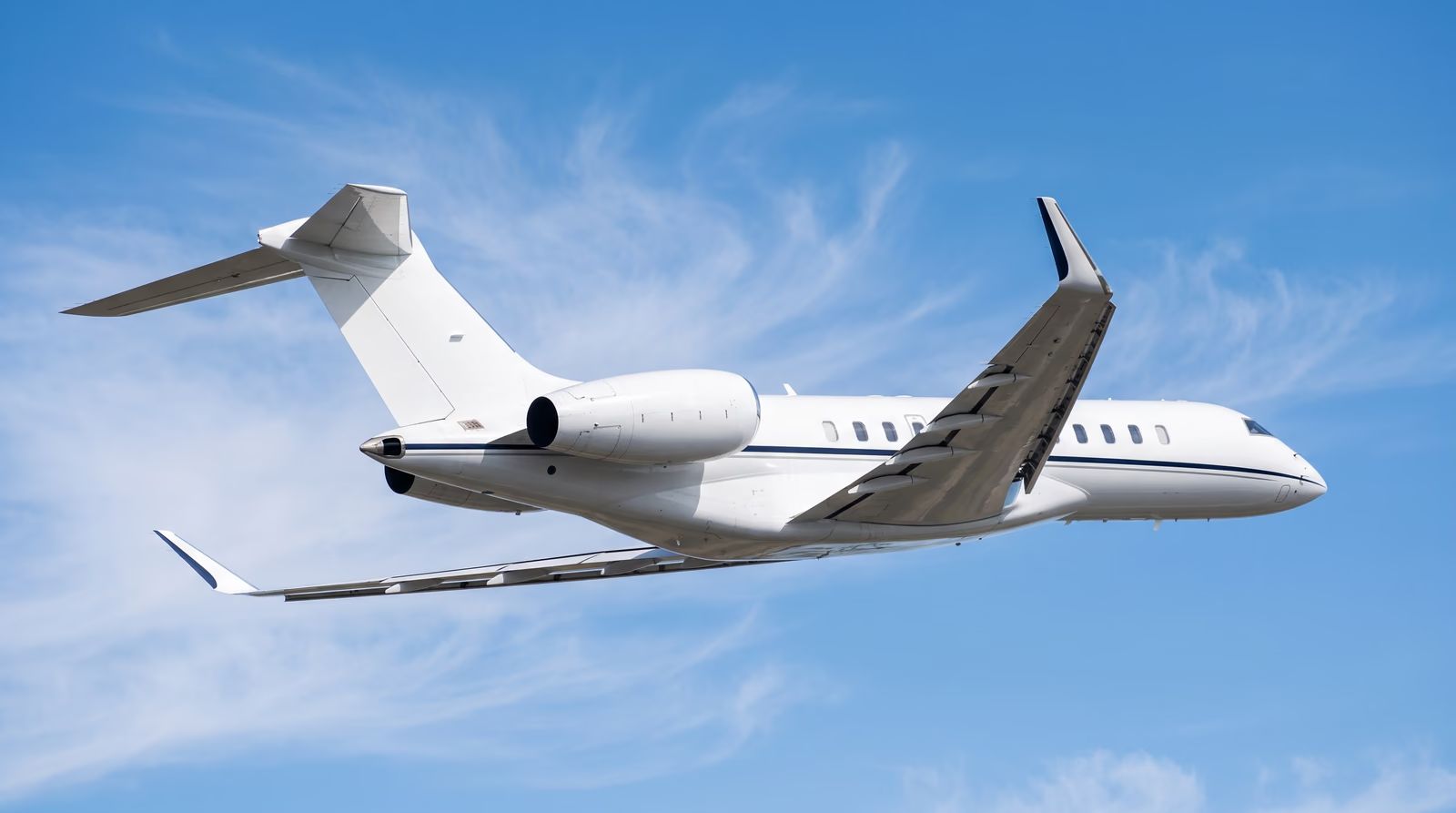
Eight days after the UK Civil Aviation Authority cleared the Bombardier Global 8000 to operate at London City Airport, the airport's own approved aircraft list carried 210 aircraft belonging to 124 operators. Nineteen of them were Bombardier Globals. Not one was a Global 8000.
That is not a contradiction or a delay. It is how steep approach access works, and the part the announcement does not tell an owner.
What Bombardier actually announced
On 10 September 2026, Bombardier said the UK CAA had approved the Global 8000 to land at London City, with immediate effect. The aircraft entered service in December 2025, having been type certified by Transport Canada, the FAA and EASA between November 2025 and January 2026, and is marketed on a top speed of Mach 0.95, a range of 8,000 nautical miles and a cabin altitude of 2,691 feet.
Bombardier framed the value in ground time, saying London City saves up to 60 to 90 minutes of transfer, and naming Singapore, Los Angeles, Honolulu and Buenos Aires as reachable nonstop from a runway in the Docklands.
Then comes the sentence that changes what the approval is worth to any individual owner. Bombardier's own wording limits it to Global 8000 aircraft "registered within jurisdictions where the Global 8000's steep approach supplement has been approved by such jurisdiction's relevant aviation authority".
The approval attaches to the type, then has to be earned again by the registry, the operator and the airframe.
The regulator is explicit about this
London City is the only aerodrome in the United Kingdom that requires a steep approach capability, and the CAA's compliance guidance for operators sets out the regime plainly. Most approaches are flown at 3 degrees. Anything at 4.5 degrees or greater is a steep approach and needs specific approval. London City's glideslope was originally 7.5 degrees and has been reduced to 5.5 degrees, a change the CAA pairs with declared takeoff run, accelerate-stop and landing distances of 1,199 metres. Those declared distances, not the full physical length of the strip, are what a performance calculation works with.
Airworthiness approval appears in the aircraft flight manual as a steep approach supplement, setting a maximum approach angle and the limitations attached to it. If no such entry is in the flight manual, the CAA says, the aeroplane must be assumed not to be cleared.
The line that matters most to a buyer follows. Steep approach clearance for a type "will not automatically permit all individual aircraft of that type to operate to the maximum approved angle". It may require modification to existing equipment, including ground proximity warning systems, autopilot and flight director computers, and it brings minimum equipment list consequences. The CAA puts the burden of working out whether a specific airframe qualifies on the operator, not the manufacturer.
The operator then needs its own permission. Steep approach and landing approvals are stated on the Operations Specifications certificate issued by the authority that oversees the operator. At London City the CAA adds that the type must be acceptable to the Airport Director, that the airport is treated as a Category C aerodrome in the operations manual, and that an operator's first flight there with that aircraft should carry a type rating instructor current in steep approach operations plus the assigned inspector, to validate the training and clear the company for later flights.
One common assumption is worth correcting, because it distorts trip planning. The CAA states that steep approach clearance has never carried an entitlement to reduced landing performance: short field landing is a separate certification item.
What the airport's list shows
London City publishes the result, and it is the most useful document in the story: an approved list naming each operator and each type cleared to land, depart and be handled.
The Bombardier Global family is well represented, with eight Global 6000s, five Global 5500s, three Global 6500s and three Global 7500s. The Global 7500 entries belong to Global Jet Austria, MP Air and NetJets Aviation. The Global 8000 appears nowhere.
Cleared for London City, and still not on the list
The Global 8000 holds UK CAA approval for London City Airport. The airport's own approved aircraft register, checked on 18 September 2026, tells an owner what still has to happen.
Bombardier Globals approved at London City
Entries on the airport's approved operators and aircraft register, by variant.
Why London City needs its own approval
Approach angles, and the point at which the UK CAA requires specific approval.
- 3 degrees. The angle most approaches are flown at, anywhere.
- 3.5 to 4.5 degrees. No specific requirement, but the operator must satisfy itself on handling and performance.
- 4.5 degrees and above. Defined as a steep approach. Specific approval required.
- 5.5 degrees. London City today, with declared takeoff run, accelerate-stop and landing distances of 1,199 metres.
- 7.5 degrees. London City's original glideslope, since reduced.
The four gates between a type approval and your aircraft
All four must be satisfied before a specific aircraft can use the airport.
Sources: London City Airport approved operators and aircraft register, checked 18 September 2026. UK Civil Aviation Authority, Steep Approach Approval Compliance Statement and Checklist, form SRG1846. Bombardier press release, 10 September 2026.
The reason is arithmetic rather than reluctance: the fleet is months old and very small. Bombardier delivered the first aircraft to NetJets on 26 March 2026, calling NetJets the fleet launch customer, and said NetJets plans a 24 aircraft fleet while upgrading its in service Global 7500s. NetJets already sits on London City's approved list with four different Global variants, so it holds the operator approvals and the airport relationship a first Global 8000 movement would need.
There is a second, operational observation in that list for a Gulf owner. The register is dominated by European air operator certificates, with 42 entries held by German companies and 21 by Belgian and Dutch ones. Only three of the 210 entries carry an operator name pointing to the Gulf or the wider Middle East, and none is a large cabin Bombardier. An owner in the region who wants London City in the near term is realistically looking at an operator that already holds the approval rather than bolting it onto an existing management arrangement. The same logic shapes departure planning from the region's own fields, covered in which UAE airports serve private aviation.
The four things that have to be true
The approval is real and worth having. It simply resolves into a checklist rather than a green light.
The aircraft needs a steep approach supplement in its flight manual, recognised by the authority of the jurisdiction it is registered in. The airframe needs the equipment standard and serviceability that supplement demands. The operator needs a steep approach and landing approval on its Operations Specifications, and crew current for it. And both operator and aircraft need London City's own acceptance, with that first validated flight behind them.
Until those four line up, the world's fastest civil aircraft reaches central London the way every other ultra long range jet does, from somewhere further out. Buyers weighing range against airport access will find the wider trade offs in the best private jets for transatlantic flights in 2026.